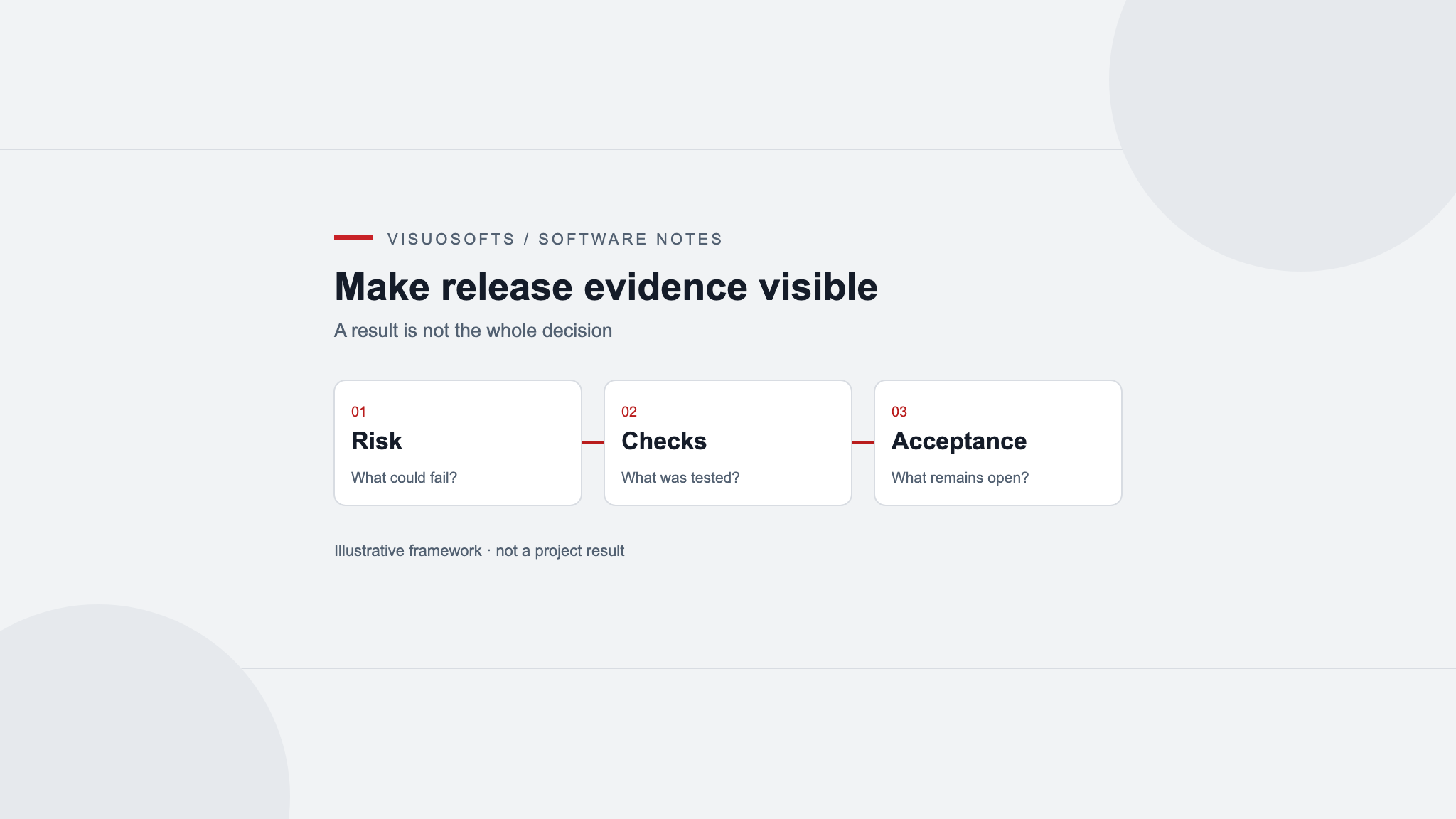
A release demonstration usually shows the intended journey under favourable conditions. Quality assurance needs to establish what happens across the important conditions the product will encounter, and acceptance needs someone to decide whether the remaining uncertainty is tolerable. Neither activity can be replaced by counting completed tickets.
This guide focuses on organising release evidence across a software project. Individual feature criteria remain important, but the wider strategy must also cover integration, operational behaviour and the risks that span several features.
Start with consequences rather than test counts
Identify the outcomes the business cannot afford to misunderstand: a lost request, a duplicated commitment, exposure of another customer's information or a system unavailable during a critical task. Describe the user and operational consequence of each, then choose evidence proportionate to that consequence.
Hypothetical example: a repair-booking application schedules collection visits. A cosmetic spacing defect is inconvenient, but assigning the same vehicle to incompatible visits could disrupt operations. Both belong in the defect record; they should not carry the same release significance.
Record likelihood assumptions cautiously. A rare event may still deserve a focused test when its consequence is severe. Conversely, an elaborate test suite for an unused cosmetic variant may contribute little to the release decision.
Connect requirements to several evidence layers
Use a traceability table linking each important requirement or risk to its checks, environment, result and reviewer. Some behaviour is best tested at component level, some through integration and some through an end-to-end journey. Avoid forcing every question into one testing method.
Automated checks can repeatedly exercise known rules. Exploratory testing can investigate interactions the team has not fully specified. User acceptance testing checks whether the agreed work can be completed in its business context. These activities complement each other rather than competing for one final sign-off slot.
For the fictional booking application, component checks might verify scheduling rules while integration tests confirm that accepted bookings reach the dispatch service. An operational rehearsal then checks whether staff can identify and resolve a rejected dispatch without making a second booking.
GOV.UK quality-assurance guidance recommends testing normal and unusual conditions and checking that changes do not break existing functionality. Use those principles to select evidence for your risks; the guide is not a certification that any particular test suite is complete.
Make the environment part of the evidence
Record the application version, configuration, dependency versions and data set used for each important result. A test against one configuration should not silently certify a different release. Identify substitutes such as payment sandboxes or simulated external services.
GOV.UK pre-production guidance describes staging that closely resembles production. Document any remaining differences: resemblance alone does not prove that a real external integration has been exercised.
Choose test data covering the operational range: missing optional fields, long histories, uncommon states and competing actions. Fabricated records can preserve the relevant complexity without exposing customer data. A collection of tidy examples may conceal the very failures the strategy is meant to find.
Document meaningful differences from the intended operating environment. These might include connection limits, service plans, account permissions or disabled scheduled tasks. Decide which differences require another check and which are acceptable limitations of the evidence.
Agree defect decisions before the deadline
Define severity using user impact, available workarounds and the scope of affected activity. Keep severity separate from delivery priority: a small defect may be quick to fix, while a serious one may require a larger decision about delaying or restricting release.
For every unresolved defect, record reproduction steps, affected versions, expected behaviour and an owner. If a workaround exists, test it with the receiving team. A theoretical workaround that requires database access unavailable to support is not a usable mitigation.
Specify who can accept a limitation and under which conditions. Technical staff can explain consequences, but a business decision may be needed to restrict an audience or pause a workflow. Record the decision and review date instead of treating silence as acceptance.
Include checks that cross feature boundaries
Look for combinations that individual feature tests may miss. A permission change during an export, a retry after a successful external action or a deployment while work is queued can expose behaviour spanning several components.
- Confirm that permitted users can complete the task and unrelated users cannot.
- Interrupt a connection after submission and inspect whether work is lost or duplicated.
- Check that dates, amounts and identifiers retain their meaning across integrations.
- Exercise the interface with keyboard navigation and relevant assistive technology.
- Verify operational visibility when a background task fails.
- Rehearse recovery using the intended support responsibilities.
Run failure, retry and recovery scenarios in an isolated authorised environment with synthetic data and controlled substitutes. Do not trigger real bookings, payments or notifications as an incidental test. Any necessary live check requires a separate agreed scope with the system owner.
Choose relevant scenarios rather than adopting this list as universal coverage. Assign a reviewer who understands the particular risk. A checklist with every box marked can still omit the failure most important to your product.
Control changes after evidence is collected
Define which changes invalidate earlier results. A text correction may need a focused review; a revised permissions component may require broader regression checks. Use the affected behaviour and dependencies to decide, rather than repeating everything automatically or assuming previous evidence always remains valid.
Keep the release candidate identifiable. If developers continue changing the same environment while reviewers test it, results become difficult to interpret. Agree how fixes enter a candidate and how testers know which version they are assessing.
In the hypothetical booking system, a scheduling fix should trigger checks for the relevant conflict rules and affected dispatch behaviour. Record why the chosen regression scope is sufficient, including shared dependencies that could be affected. Broaden it when the impact is uncertain; a check labelled unrelated is not automatically safe to omit.
Build a concise acceptance record
The release pack should summarise the candidate, covered risks, completed checks, environmental limits, unresolved defects and operational readiness. Link to detailed evidence so decision-makers can investigate without reading every test log during the meeting.
Record whether the decision is full release, restricted release, further testing or no release. A restricted release needs an explicit audience, monitoring responsibility and condition for expansion. Confirm who can stop the rollout if the observed behaviour differs from the evidence.
For deeper checks, use the role-permission test matrix and the support handover guide. These cover authorisation and operational readiness respectively, not a substitute for usability research. Visuosofts' application development service provides a route to discuss delivery requirements. Contact Visuosofts with your critical journeys and release risks to define the acceptance strategy.
Release acceptance questions
Does a passing automated suite mean the release is ready?
It establishes results for the checks and conditions exercised. Review uncovered risks, environment differences, exploratory and user evidence, unresolved defects and operational readiness before the authorised release decision.
What belongs in the acceptance record?
Identify the candidate and its configuration, risks tested, evidence links, reviewers, environment limitations and remaining defects. Record the decision, accepted exceptions, owners and any audience restrictions or conditions for expansion.
How much regression testing follows a fix?
Assess the changed behaviour and shared dependencies, then record the selected checks and rationale. Broaden testing where impact is uncertain. Earlier results must remain traceable to the candidate they actually tested.
Who can accept a known limitation?
The person with the agreed authority for the affected risk must make and record that decision. Technical explanation is necessary, but silence or a completed ticket is not approval. A proposed workaround also needs evidence that the receiving team can use it.