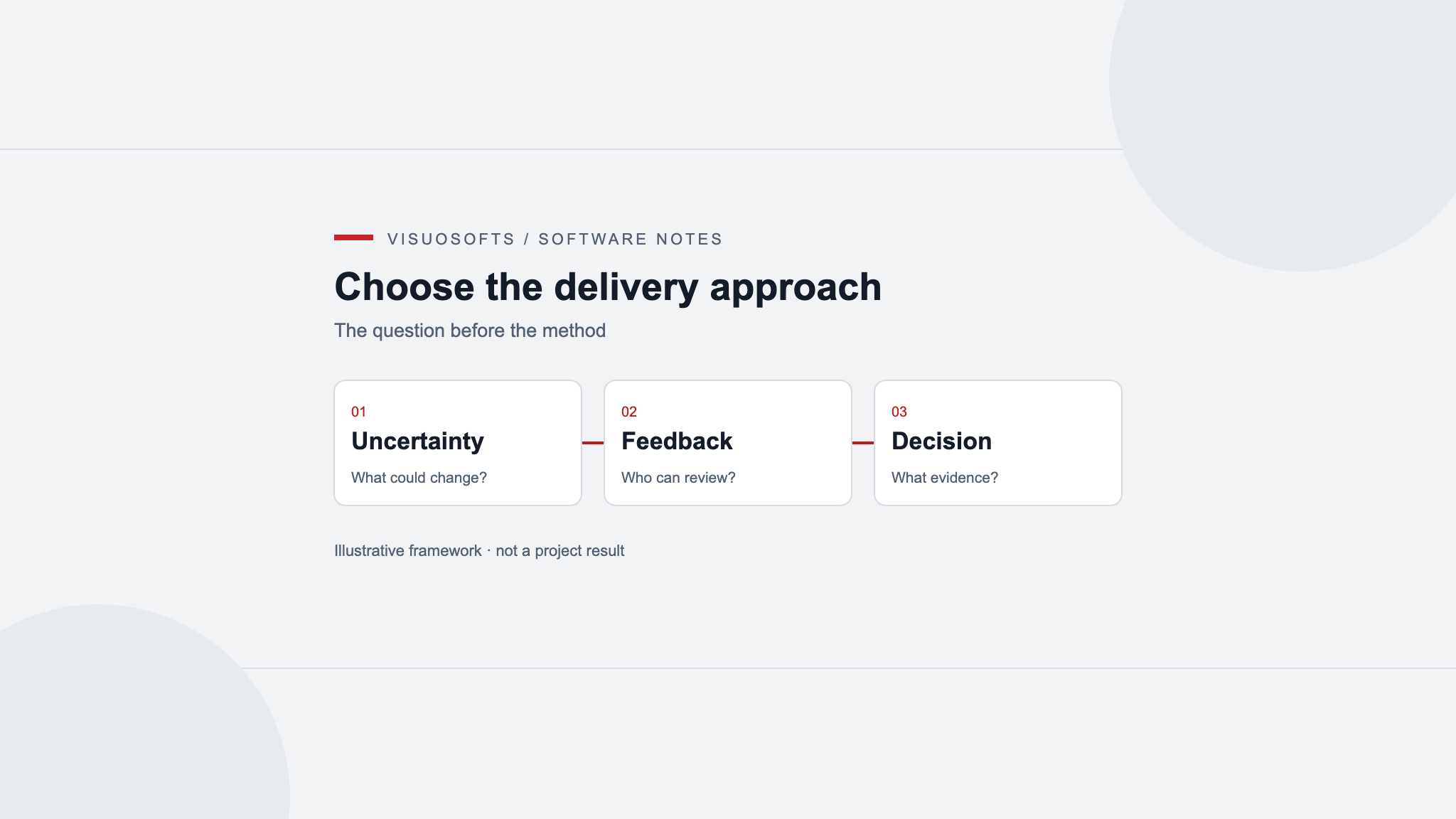
Choosing Agile or waterfall is less useful than deciding when your project can obtain reliable answers. Some requirements are understood before development begins. Others become clear only when users try working software. The delivery approach should fit that pattern of uncertainty and the organisation's ability to make decisions.
For this guide, waterfall means work organised mainly through sequential phases with formal transitions. Agile means an iterative approach that uses frequent feedback to adjust delivery. Actual projects vary, so agree the working practices rather than relying on either label.
Identify what could change your plan
Separate uncertain customer needs from known technical obligations. You may know that a system must exchange a particular file format while remaining unsure how staff should review rejected records. Treating both as equally settled encourages either premature specification or unnecessary experimentation.
List important assumptions and the evidence needed to resolve each. Some questions can be answered through documentation or a short investigation. Others require a working slice of the product. Record how long an incorrect assumption could remain hidden under the proposed delivery sequence.
The Agile Manifesto's principles emphasise frequent delivery, collaboration and responding to changing requirements. They do not remove the need for planning or technical discipline. Use those principles to assess your feedback arrangements, not as a reason to leave responsibilities undefined.
Check whether feedback is actually available
An iterative plan needs people who can review outcomes and make timely choices. Name the product decision-maker, the users who can participate and the specialists needed for particular questions. Confirm their availability against the proposed review rhythm.
If users are available only at occasional milestones, a weekly demonstration alone will not produce useful learning. Plan targeted research in advance, give reviewers realistic tasks and establish how unresolved questions affect development. Otherwise the team may repeatedly demonstrate progress without correcting its direction.
A sequential approach also needs feedback before final acceptance. Review prototypes, interface contracts and test evidence at appropriate points. Waiting until the end to discover a misunderstood workflow is not a necessary feature of formal planning.
Map dependencies that constrain sequencing
Identify procurement, external interfaces, hardware delivery and approval events that limit when work can proceed. Ask which decisions must become stable early and which can remain open. A fixed external interface does not necessarily require every internal screen to be specified at the same time.
Hypothetical example: a laboratory needs a reporting application connected to an instrument arriving later in the project. The instrument's export format is documented, but staff have not agreed how to review unusual readings. The team can stabilise the import contract while iterating on the review interface with representative sample files.
That arrangement needs a later test against the actual instrument. A simulated input helps development proceed but does not establish compatibility with equipment that has not arrived. Make this unresolved dependency visible in the release plan.
Compare approaches against the same questions
Use a short decision worksheet with evidence, rather than a general score for which method sounds more modern. Discuss the following questions with the people who will fund, review and operate the product:
- How stable are the essential workflows, and what supports that judgement?
- How soon can users inspect something representative of the final experience?
- Which external commitments require an early, controlled specification?
- Can the business accept smaller releases or only one coordinated introduction?
- Who can change priorities, and how quickly can they decide?
- What evidence is required before funding or delivery moves to the next stage?
Keep reasons beside the answers. A preference for one coordinated introduction might come from training constraints, not a technical requirement. Understanding the reason creates options, such as iterative development followed by a planned operational launch.
Define how change will be handled
For a sequential plan, explain how a proposed change is evaluated against the agreed baseline. Record its effect on scope, dependencies, effort and acceptance. A change process should enable informed decisions rather than make necessary corrections disappear into informal conversations.
For iterative work, explain who orders the backlog and what remains committed for the current period. A flexible backlog does not mean every new request interrupts work immediately. Keep the consequence visible when a new priority displaces an existing one.
In either approach, distinguish a defect against an agreed requirement from a new requirement. Resolve disputed cases through the decision owner using the recorded intent and acceptance evidence. Methodology terminology should not substitute for that discussion.
Make mixed delivery coherent
A project can combine early feasibility work, controlled architecture decisions and iterative feature delivery. The risk is creating two incompatible reporting systems: one assuming a fixed feature list and another assuming continual reprioritisation.
Explain what each milestone means. It might approve a technical boundary, release a usable capability or authorise the next funding stage. Link the milestone to evidence and a named decision. Avoid presenting percentage-complete figures that hide whether important uncertainties remain unresolved.
For the hypothetical laboratory project, import validation can have a formal approval while the review interface evolves through observed tasks. The final readiness decision still requires both to work together. Separate workstreams need a shared integration check.
Review the approach when conditions change
Revisit the delivery arrangement if feedback becomes unavailable, dependencies shift or the main uncertainty changes. Record what is changing and why. Do not switch methods solely because one meeting felt unproductive; first investigate whether ownership, evidence or preparation was missing.
Delivery method and commercial model are separate decisions: a fixed-price agreement does not inherently mean waterfall, and time-and-materials does not inherently mean Agile. For supplier arrangements, read the software outsourcing guide and agree who can approve scope and priority changes. For implementation discussions, review Visuosofts' application development service. Contact Visuosofts with your uncertain requirements, external commitments and reviewer availability to discuss a delivery approach grounded in the project.
Agile and waterfall questions
Which approach should we choose when requirements are uncertain?
Start by identifying the uncertainty and when useful feedback can arrive. Iterative delivery can support learning from working software, but only if reviewers and decision-makers are available. Record dependencies and approval needs before choosing the practices.
Can iterative development have a fixed launch date?
Yes, a planned operational launch can follow iterative development. Agree which scope is essential, how trade-offs will be decided and what evidence is required at release. A date alone does not establish that every requested feature can fit.
Does waterfall mean users only review the finished product?
No. A sequential plan can include prototype reviews, interface checks and early acceptance evidence. Define those opportunities explicitly rather than postponing every important question until final delivery.
Does an Agile label remove change control?
No. Name the person who orders priorities and record what a new request displaces. Distinguish a defect against agreed behaviour from a new requirement, whichever delivery approach is used.