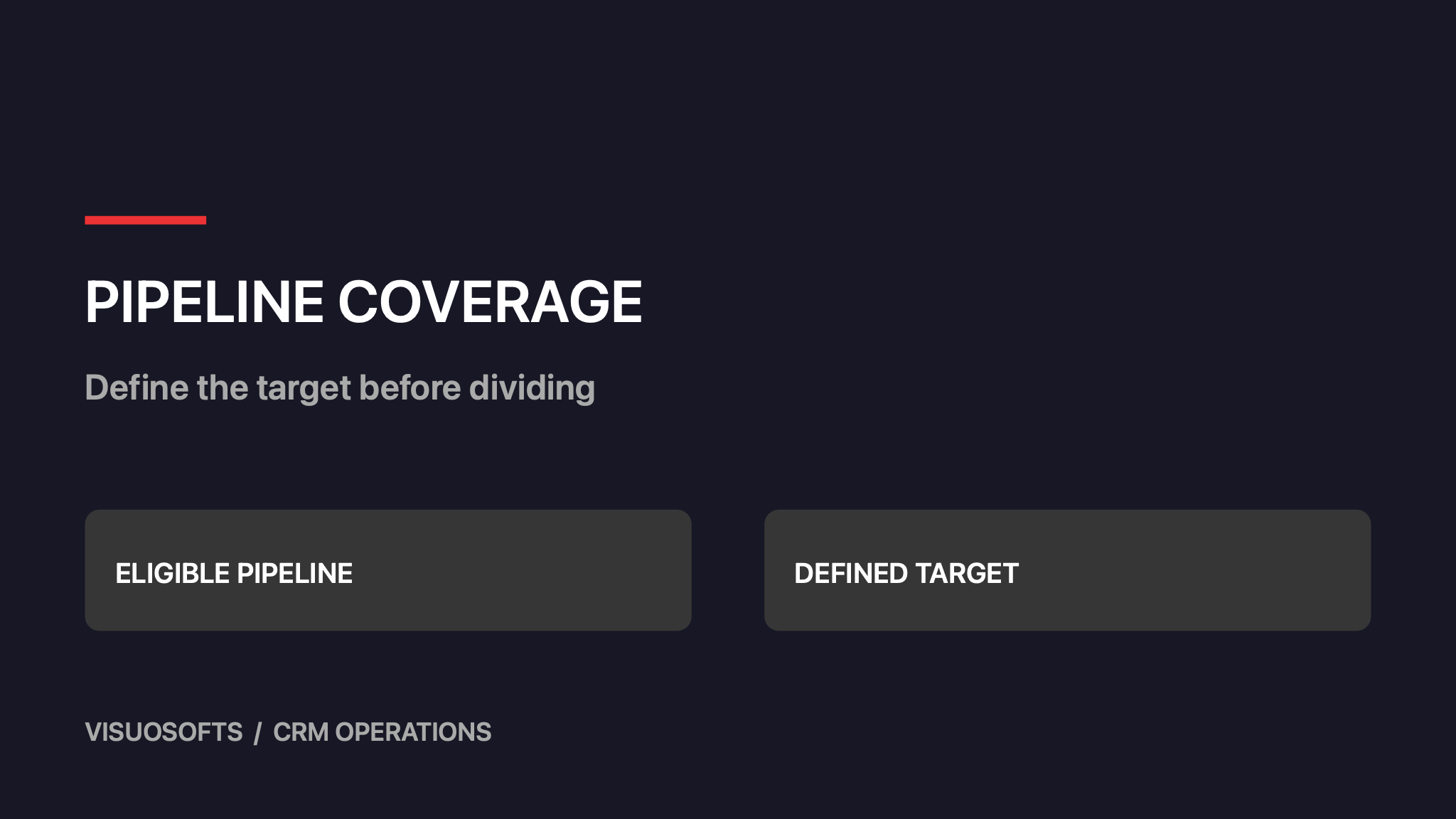
A CRM pipeline coverage ratio compares eligible open opportunity value with a defined sales target or remaining target. It is a planning signal, not a promise that the work will close. The ratio becomes useful when the numerator and denominator use the same period, currency and commercial basis, and when managers can inspect what makes the number move.
Choose the question before choosing the denominator
Two reasonable questions produce different ratios. You might ask how the open pipeline compares with the full quarterly target, or how it compares with the amount still required after confirmed wins. Label the chosen measure clearly. A dashboard that silently switches between those denominators can look dramatically healthier without a single new opportunity.
For a remaining-target view, calculate the target less the qualifying wins already recorded for that same period and basis. If the target is met or exceeded, show that state rather than dividing by zero or a negative number. Keep the open pipeline visible separately so the team can still discuss future work.
Define eligible pipeline with the same discipline
Specify which stages and expected decision dates qualify. Exclude closed records, duplicate alternatives and opportunities whose dates fall outside the target period. Show undated opportunities as an exception group. Quietly assuming every missing date means this quarter can inflate coverage and hide the very uncertainty managers need to discuss.
Match the value basis. If the target measures accepted contract value, the pipeline should use comparable contract value rather than monthly fees or possible lifetime income. Keep currencies separate unless the business has an agreed conversion method. Document how optional scope, renewals and expansion opportunities are treated before adding them together.
Worked hypothetical example: full versus remaining target
A fictional supplier has a quarterly accepted-order target of £200,000 and has already won £80,000 on the same basis. Its remaining target is £120,000. Eligible open opportunities total £360,000. Open pipeline divided by the remaining target gives coverage of 3.0 times; divided by the full target it gives 1.8 times.
Both calculations are arithmetically correct, but they answer different questions. Now suppose a £90,000 opportunity moves into the next quarter. Eligible pipeline falls to £270,000 and remaining-target coverage becomes 2.25 times. Nothing was lost, yet the current-quarter picture weakened because timing changed.
Return to that £270,000 eligible pipeline. If £60,000 then closes as a qualifying win, open pipeline becomes £210,000 and the remaining target becomes £60,000. Coverage rises to 3.5 times. The higher ratio reflects a smaller remaining requirement despite less open work. These fictional amounts illustrate the mechanics, not a market benchmark or client performance.
Do not borrow a universal coverage target
The ratio a business finds useful depends on its conversion, deal sizes, timing and opportunity definitions. A broad early-stage pipeline and a narrowly qualified late-stage pipeline cannot be judged against the same threshold without context. Avoid declaring that every company needs a particular multiple simply because it sounds familiar.
Use your own historical snapshots to investigate what was present at comparable points in earlier periods and what eventually closed within those periods. Explain the sample size and material changes in the business. A few past quarters can inform discussion, but they do not establish a dependable rule when products, sales cycles or qualification standards have changed.
Distinguish coverage from a weighted forecast
Unweighted coverage counts eligible opportunity value before probability adjustments. A weighted forecast applies assumptions about likely outcomes. Keep the labels separate. Multiplying pipeline by stage weights and calling the result ordinary coverage conceals a second model inside what appears to be a simple ratio.
Even a well-labelled weighted model may not reflect timing or dependencies. Several opportunities can depend on the same customer's budget approval, so their outcomes are not necessarily independent. Show the underlying records and the reason for their expected decision dates. A precise decimal should not make weak assumptions appear settled.
Check concentration and available delivery capacity
Break the numerator into a few useful segments: stage, expected decision month, customer group or opportunity owner. Show the largest opportunities and their share of eligible value. A ratio dominated by one uncertain tender needs a different conversation from the same ratio spread across many smaller, well-understood purchases.
Ask whether the business can fulfil the potential wins within the proposed commitments. Coverage measures sales opportunity value, not implementation capacity. If several deals depend on the same specialist team, flag that dependency for planning rather than treating the entire pipeline as simultaneously deliverable.
Use a reconciliation checklist before the pipeline meeting
- Confirm the target period, value basis and currency.
- Reconcile qualifying wins before calculating the remaining requirement.
- Remove closed records and avoid adding alternative quotes twice.
- Review missing or stale expected decision dates separately.
- Explain additions, wins, losses and date movements since the previous snapshot.
- Display concentration and the records behind the ratio.
Retain a snapshot at each review point. Recalculating last month's coverage from today's edited opportunities can erase the original planning context. Record changes to eligibility definitions as well, so an apparent improvement is not simply the result of loosening the rules.
Turn the ratio into a specific decision
A low ratio might justify investigating delayed opportunities, improving qualification or creating more suitable demand. It does not identify the cause by itself. Read CRM reporting and pipeline metric definitions to document the population and value basis behind the ratio. Explore Visuosofts CRM development or contact Visuosofts with your target definition and a sample pipeline snapshot to design a report the team can explain.