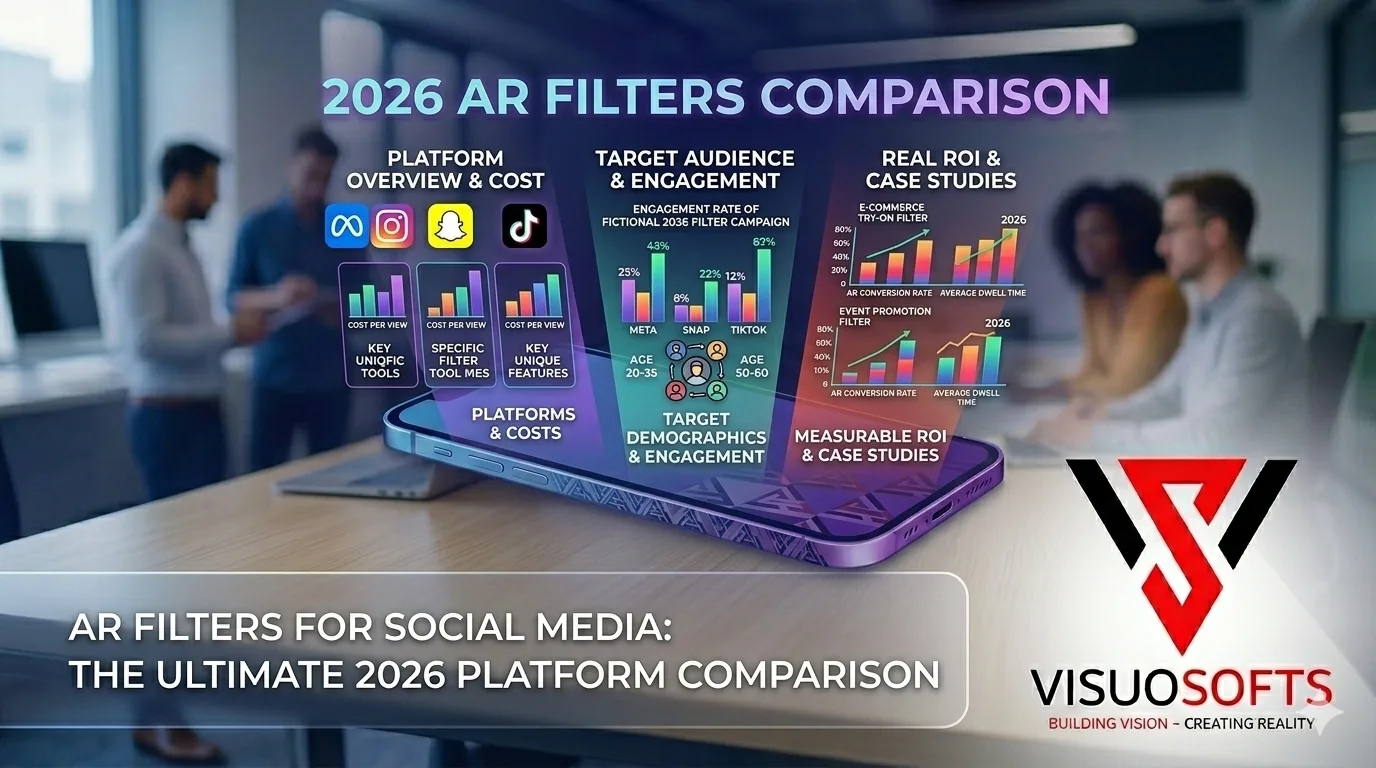
AR filters for social media now span two open platforms — TikTok and Snapchat — plus WebAR for everywhere else, each with a different ROI for a branded campaign. Complete comparison with costs, engagement data, and strategic recommendations.
AR filters have evolved from novelty features into powerful marketing tools driving billions of impressions and measurable business results across social media platforms. In 2026, with over 350 million daily AR lens users on Snapchat alone, and TikTok reporting similarly massive engagement, brands face a critical strategic question: which platform delivers optimal ROI for AR filter campaigns?
At Visuosofts, we have built branded AR filters for clients in the UK, Kuwait and Pakistan. The landscape has shifted dramatically—Instagram held 64% market share for branded AR in 2022, but Meta closed its filter platform to outside creators in January 2025, leaving TikTok and Snapchat as the open options, while Snapchat maintains technical superiority despite ranking third in adoption.
This comprehensive guide examines each platform's strengths, costs, audience demographics, technical capabilities, and strategic fit. Whether you're a Kuwait beauty brand launching virtual try-on, a UK retailer creating product visualization, or any business exploring AR marketing, understanding these platform differences is essential for campaign success.
🎯 Platform Overview: TikTok vs Snapchat (and what happened to Instagram)
Where branded effects can still be published, and where they cannot
Instagram & Facebook
Closed to third-party effects since 14 January 2025
- Closed to third-party creators since January 2025
- Massive reach across millennials/Gen Z
- Strong shopping/e-commerce integration
- First-party Meta effects only
- Influencer marketing ecosystem
- Reachable via WebAR linked from posts and ads
TikTok
"Viral content & unmatched reach potential"
- Effect House (advanced creator platform)
- Explosive viral potential (50-100x Instagram)
- Younger, highly engaged audience
- Algorithm-driven discovery
- User-generated content amplification
- Community Effects (€1K-5K) vs Branded (€120K+)
Snapchat
"AR pioneer & technical sophistication leader"
- Lens Studio (most advanced AR tools)
- Virtual Try-On (clothing, shoes, watches)
- Shoppable AR lenses (direct purchase)
- Strong Gen Z loyalty despite competition
- Advanced body/hand tracking
- Snap Map & location-based lenses
📊 Complete Feature Comparison Matrix
| Feature / Capability | Instagram (closed) | TikTok | Snapchat |
|---|---|---|---|
| Face Tracking Quality | Excellent | Excellent | Industry Leading |
| Body Tracking | Basic | Good | Advanced |
| Hand Tracking | Limited | Good | Best-in-class |
| Virtual Try-On (Clothing) | No | No | Full Support |
| 3D Objects/Assets | Full | Full | Advanced |
| Creator Tools Ease | User-friendly | Good | Complex |
| Direct E-commerce | Extensive | Growing | Shoppable Lenses |
| Viral Potential | High | Extreme (50-100x) | Moderate |
| Organic Reach | Declining | Excellent | Limited |
| Analytics Depth | Good | Basic | Comprehensive |
| Ads Integration | Seamless | Good | Advanced |
| Development Cost | €1,000-5,000 | €1,000-5,000 (Community) | €1,000-5,000 |
| Platform Fee | Free | Free (Community) | Free |
What actually makes an effect get shared
Reach is not bought on these platforms so much as earned, and the mechanics of earning it are consistent enough to design for.
An effect spreads when using it produces something the person wants to post. That sounds obvious and it is routinely ignored, because the brief usually arrives as "we want a filter with our logo on it". Nobody has ever shared a photograph of themselves in order to show their friends a logo. They share because they look good, because it is funny, because it revealed something, or because it invited a response.
The four mechanics that reliably do this:
- Transformation. The person looks different in a way they like. Beauty effects and virtual try-on sit here, and they are the most durable category because the appeal does not depend on a trend.
- Randomisation. "Which one are you" — the outcome differs each time, so there is a reason to try again and a reason to compare with a friend.
- Challenge. A score, a timer, a thing to beat. This is what turns a single use into a duet or a stitch, which is where TikTok distribution actually lives.
- Revelation. The camera shows something that is not there — the inside of a product, a room redecorated, a historical overlay. This is the one that works best for brands that are not consumer-facing.
Branding attaches to whichever of those you choose. It does not substitute for one.
Writing a brief that produces a good effect
Most disappointing effects trace back to a brief that specified the wrong things. A useful brief is short and answers these:
- What does the person get out of using this? Answer in the shape of "they look…", "they find out…", "they beat…". If you cannot finish that sentence, stop here.
- Where will it be seen first? An effect nobody is sent to does not spread on its own. Name the creators, the ads or the on-pack QR code that seeds it.
- What must be recognisably yours? Usually a product shape or a colour, not a wordmark. A logo floating over someone's head reads as an advert; a product they can wear reads as an effect.
- What is the one action afterwards? A link in bio, a code, a page. Decide before the build, not after.
- How will you know it worked? Impressions are not the answer. Saves, shares and the traffic reaching your destination are.
Review, approval and the timeline nobody plans for
Both platforms review effects before they go public, and both can reject them. Build the review window into your schedule rather than discovering it the week of launch.
Rejections tend to come from the same places: effects that imply a medical or health claim, anything that could be read as promoting a restricted product, third-party trademarks you do not own, and effects whose performance is poor enough to degrade the app experience. Beauty and cosmetics effects get particular scrutiny because of the claims risk.
What a branded effect actually costs you
We are not going to publish a price list, because the range is genuinely wide and any single figure would mislead. What we can give you is the list of things that move it.
- Tracking type. A face effect is well-trodden. World tracking, hand tracking, segmentation or a game loop each add real build time.
- 3D asset production. If your product needs modelling from scratch, that is a separate cost and often the larger one.
- Platform count. Snapchat and TikTok use different tools and different formats. The creative and 3D assets carry across; the build does not.
- Paid placement. Building the effect and buying reach for it are separate budgets. TikTok's Branded Effect route in particular is a media buy, not a production cost.
- Revision rounds. Agree the number up front. This is where these projects overrun.
The honest framing: treat a social effect as media spend with a campaign-length life, and treat WebAR as an asset you keep. Comparing their prices directly is a category error, which is why those conversations go in circles.
Measuring it properly
Platform analytics for effects are shallow, and they stop at the platform boundary. You can usually see impressions, uses and shares. You cannot see what happened next, which is the part your finance director will ask about.
So instrument the part you control. Give the effect a single destination with its own tracking parameter, and watch sessions arriving from it. If the effect is meant to drive a specific action, put that action behind a URL only reachable from the effect, so attribution is unambiguous rather than modelled.
Two numbers worth more than impressions: share rate, because it tells you whether the mechanic worked, and cost per session on your own site, because it is the only figure comparable with your other channels.
When a filter is the wrong answer
Skip the effect if: your buyers are not on Snapchat or TikTok, which is true for most B2B; you need the experience to persist beyond a campaign; you need it linkable from packaging, print or email; or you need it to sit next to a buy button.
All four of those point at WebAR instead. There is no shame in concluding that the answer is a page on your own domain — it is usually the cheaper answer per useful month, and it is one nobody can switch off.
Frequently Asked Questions
Which platform gives the best ROI for a branded AR filter: TikTok or Snapchat?
It depends on the audience and goal — Snapchat still leads on AR engagement rates and cost efficiency for younger demographics, and TikTok drives the highest share and virality per view. Instagram is no longer an option for custom branded filters: Meta closed Spark AR to third-party creators in January 2025. To reach a Meta audience, run WebAR on your own domain and link to it from posts and paid placements.
How much does a branded AR filter cost to produce?
A single social AR filter typically falls in the same range as a single-product WebAR build — most projects cost £2,500-£6,000 depending on complexity, with event or campaign-scale filters running higher.
Do AR filters need to be rebuilt separately for each platform?
Largely yes — each platform has its own filter format (Lens Studio for Snapchat, Effect House for TikTok), though the creative and 3D assets can often be reused across builds, including into WebAR. Meta's Spark AR, which covered Instagram and Facebook, was closed to third-party creators in January 2025.
What makes an AR filter actually get shared?
Using it has to produce something the person wants to post. Four mechanics do this reliably: transformation, where they look different in a way they like; randomisation, where the outcome differs each time and invites comparison; challenge, where a score or timer prompts duets and stitches; and revelation, where the camera shows something that is not there. Branding attaches to whichever you choose, but it never substitutes for one — nobody shares a photograph of themselves to show friends a logo.
How long does platform approval take, and can an effect be rejected?
Yes, both Snapchat and TikTok review effects before they go public and both can reject them. Common causes are implied health or medical claims, anything readable as promoting a restricted product, third-party trademarks you do not own, and performance poor enough to degrade the app. Beauty and cosmetics effects get particular scrutiny because of the claims risk. Submit well ahead of your campaign date and keep a fallback ready — a WebAR version on your own domain needs nobody's approval and can go live the same day.
How do I measure whether a branded effect worked?
Platform analytics are shallow and stop at the platform boundary, so instrument the part you control. Give the effect a single destination with its own tracking parameter and watch the sessions arriving from it. Two numbers are worth more than impressions: share rate, because it tells you whether the mechanic actually worked, and cost per session on your own site, because it is the only figure comparable with your other channels.