VISUOSOFTS · WEB DEVELOPMENT
Marketing email, transactional email — they both land in the inbox, but the law, the purpose and the best practices treat them as completely different animals. Confuse the two and you risk breaking UK email law, annoying customers, or leaving money on the table. This guide explains the difference clearly and how to handle each.
Covered: definitions, the legal position under UK GDPR and PECR, and practical guidance for getting both right.
DEFINITIONS — PROMOTION VS FACILITATION
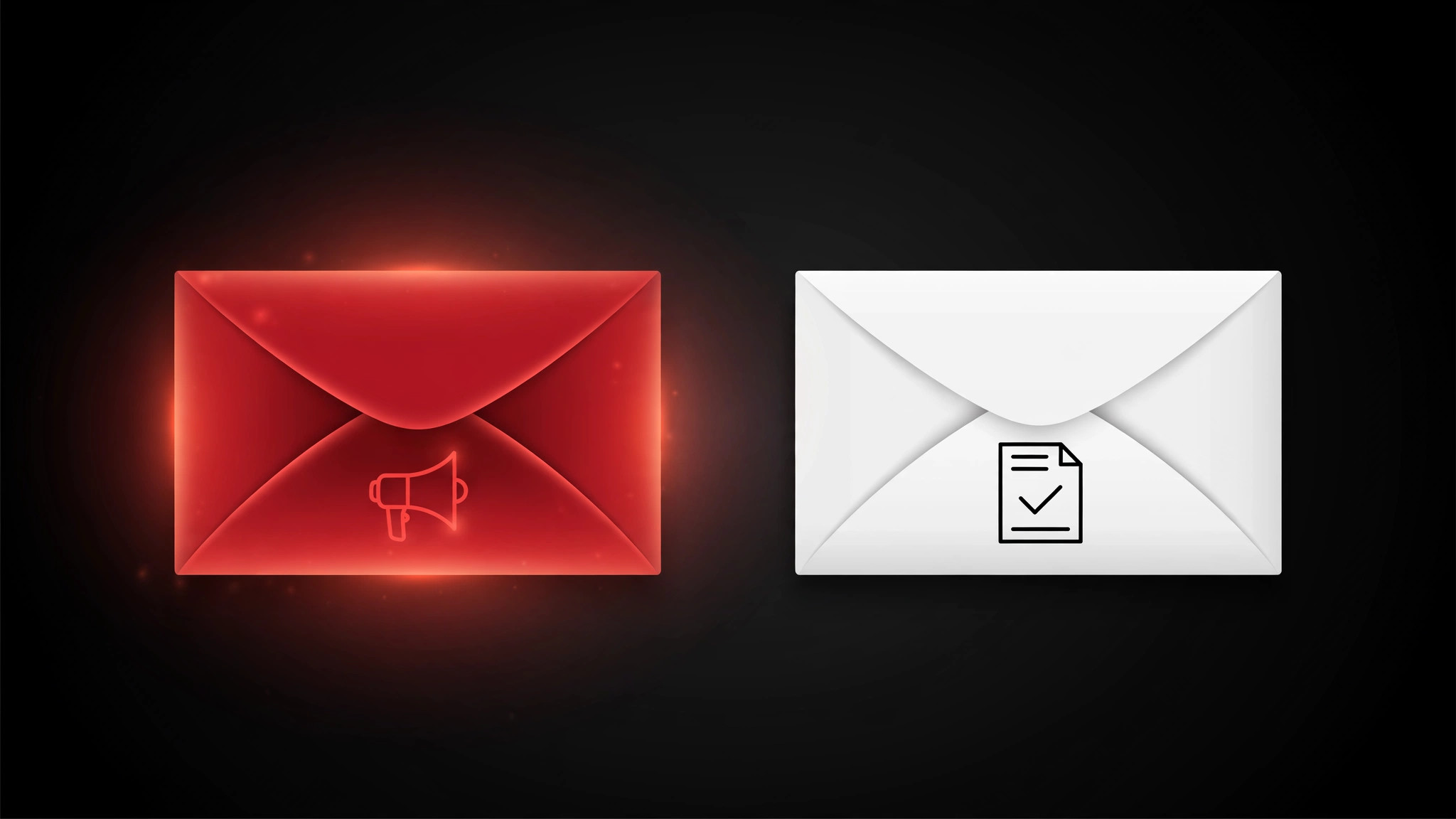
A marketing email promotes: newsletters, offers, product announcements, event invitations — anything whose purpose is to encourage a purchase or engagement. A transactional email facilitates: order confirmations, password resets, booking confirmations, delivery updates, receipts — messages the recipient needs as part of a transaction or relationship they already have with you.
The distinction matters because the rules differ. Marketing emails generally need prior consent (opt-in) under UK PECR; transactional emails generally do not, because they are a necessary part of the service. But the line is about purpose, not format — a "receipt" stuffed with promotional content is legally a marketing email wearing a disguise, and regulators see through it. Classify by honest purpose, not by convenience.
THE LEGAL DIFFERENCE — UK GDPR AND PECR
Under the Privacy and Electronic Communications Regulations (PECR), you need consent (or the soft opt-in for existing customers) before sending marketing emails to individuals. The soft opt-in has strict conditions: you obtained the address in the course of a sale or negotiations, you market similar products or services, and you gave a clear opt-out at collection and in every message. Get any of these wrong and the email is unlawful.
Transactional emails sit under GDPR's broader lawful bases — usually contract performance or legitimate interest — because the recipient reasonably expects them. But they must still be proportionate: necessary content for the transaction, a working unsubscribe or preference centre where appropriate, and no sneaking marketing into the footer. Keep consent records for marketing, document the lawful basis for transactional, and keep the two streams technically separate so a marketing suppression never blocks a password reset. This is orientation, not legal advice — take professional counsel for your specific situation. Our digital marketing team builds email programmes with this separation as standard.
MARKETING EMAIL DONE RIGHT
Good marketing email is invited, relevant and respectful. Build the list honestly — no bought lists, ever — with clear consent at signup stating what they will receive. Segment by interest and behaviour rather than blasting everyone; a smaller engaged list outperforms a large indifferent one on every metric that matters, including deliverability.
Write for the human: one idea per email, a subject line that earns the open without tricking it, and a single clear action. Respect frequency — most SMB lists do well at fortnightly or monthly; daily is for businesses with genuinely daily value. And measure beyond opens: clicks, conversions and unsubscribes per campaign tell you whether the list is healthy or just large. For the analytics side, see our email insights guide.
TRANSACTIONAL EMAIL DONE RIGHT
Transactional emails get the highest open rates of any email you send — often 70%+ — because recipients are waiting for them. That attention is an opportunity, not an excuse: make them excellent at their job first. Order confirmations should confirm clearly (what, when, how much, what next); password resets should be instant and single-purpose; booking confirmations should include everything needed (date, time, location, how to change it).
Design for clarity under stress: the customer reading a delivery email is often anxious, so lead with the status, not the branding. Keep them fast — a password reset arriving in 20 minutes is a failure — and monitor deliverability separately from marketing, because a transactional email in spam is a broken service. You may include limited related content (a delivery email mentioning the returns policy), but keep promotion minimal and clearly secondary; the moment it reads as marketing, the legal position shifts.
THE GREY AREAS — WHERE BUSINESSES GET CAUGHT
The dangerous middle ground: "service updates" that are really promotions, review requests with discount codes attached, win-back emails to lapsed customers (marketing, needs consent basis), and onboarding sequences that drift from helpful to salesy. The test regulators apply is purpose: would the recipient reasonably consider this necessary for the service, or is it encouraging them to buy? If the latter, treat it as marketing.
Practical safeguards: classify every automated email at creation as marketing or transactional and document the basis; keep the streams on separate sending infrastructure so reputation issues in one do not sink the other; and when in doubt, apply the marketing rules — consent, opt-out, suppression. The stricter standard never gets you in trouble; the looser one might.
TECHNICAL SETUP — KEEP THEM SEPARATE AND DELIVERED
Run marketing and transactional mail on separate subdomains and IP reputations (e.g. news.yourdomain.com vs notify.yourdomain.com) with proper SPF, DKIM and DMARC on both. A marketing campaign that trips spam filters should never take down your password resets. Monitor deliverability per stream — bounce rates, complaint rates, inbox placement — and act on deterioration immediately.
Maintain suppression lists rigorously for marketing (unsubscribes honoured within days, legally and reputationally), while ensuring transactional flows bypass marketing suppressions correctly. And log everything: what was sent, to whom, when, under what basis. Talk to us and we will review your email setup for compliance and deliverability — it is usually a short project with immediate risk reduction.
MARKETING VS TRANSACTIONAL EMAIL — FAQs
Can we include marketing in transactional emails?
Sparingly and carefully. Minor, related content is generally acceptable; turning the order confirmation into a sales flyer reclassifies it as marketing in the eyes of regulators. When promotion becomes a purpose of the email, apply marketing rules.
Do transactional emails need an unsubscribe link?
Not in the marketing sense — recipients cannot opt out of emails necessary for the service. But offer preference controls where sensible, and never use the transactional stream to bypass a marketing unsubscribe. That is precisely the abuse regulators punish.
What is the soft opt-in?
A PECR provision letting businesses email existing customers about similar products without fresh consent — provided you got the address during a sale or negotiations, and offered an opt-out at collection and in every message. It does not cover prospects, and "similar products" is narrower than most businesses assume.
Can we buy an email list for marketing?
Do not. Bought lists almost never have valid consent, destroy deliverability, and breach PECR. Build your own list with clear consent — slower, legal, and dramatically more effective.
How do we handle unsubscribes?
One click, no login required, honoured promptly, with a confirmation. Make it easy — every obstruction breeds spam complaints, which damage your sender reputation far more than the lost subscriber.


