VISUOSOFTS · WEB DEVELOPMENT
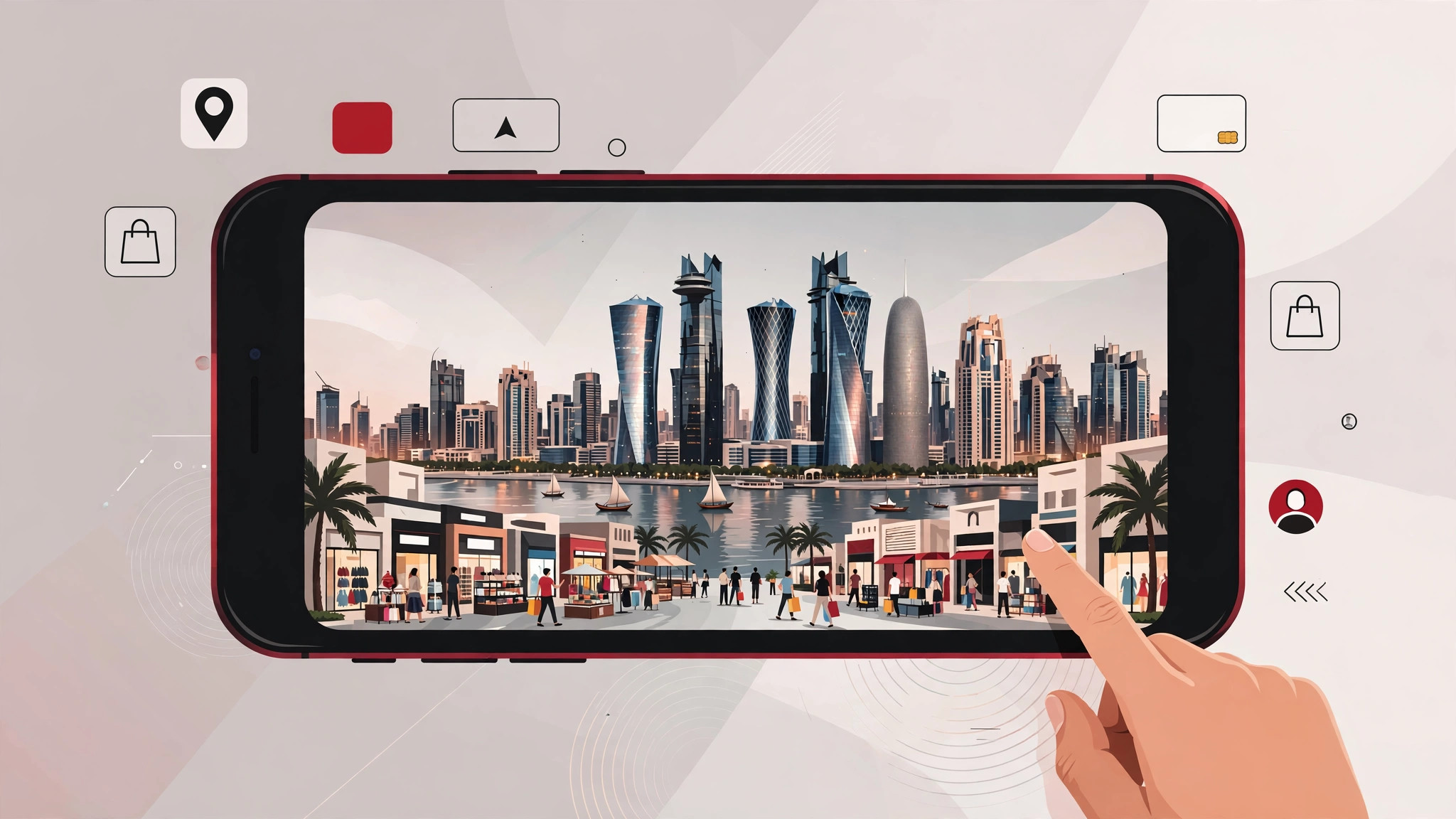
In Qatar, mobile is not a channel — it is the market. With 95% smartphone penetration and around 69% of transactions completed on phones, the Qatari customer experiences your business primarily through a 6-inch screen, often on the move, often distracted. Designing desktop-first and "checking mobile" is designing for the minority. Mobile-first is not a methodology here; it is reality.
This guide covers mobile-first design for Qatar: the principles, the Qatari specifics (bilingual, RTL, payments), performance, and testing. We build mobile-first websites for the Gulf — get a free consultation.
MOBILE-FIRST PRINCIPLES
Mobile-first means designing for the phone as the primary experience, not the adapted one: content hierarchy for small screens (the essential action visible without scrolling — call, book, buy), thumb-zone design (primary actions reachable one-handed — bottom of screen, not top corners), touch targets sized for fingers (minimum 44px — the mis-tap is a conversion killer), and forms designed for phones (few fields, right keyboards per input, autofill enabled).
The content discipline: ruthless prioritisation — the phone shows less, so what it shows must be the best. Cut the carousel (nobody swipes past slide two on mobile), cut the popups (the mobile popup is pure friction), cut the auto-play video (bandwidth and annoyance). Navigation simplified to the essential paths — the mobile menu is not a shrunken desktop menu, it is a different information architecture. Every design decision starts from the question: "how does this work on a phone, one-handed, on 4G?" Desktop is the enhancement, not the baseline.
QATARI SPECIFICS: BILINGUAL, RTL, AND LOCAL
Qatar's mobile web is bilingual: Arabic-first or genuinely bilingual interfaces, with proper RTL layout for Arabic (mirrored navigation, right-aligned content, mirrored icons — not just translated text in a left-to-right shell). Arabic typography needs larger sizes (Arabic glyphs render smaller than Latin — bump 10%+), and mixed-direction content (QAR prices, +974 numbers, Latin brand names inside Arabic text) needs proper bidi handling or it renders as garbled text.
Local integration points: click-to-call and WhatsApp chat as primary contact actions (Qataris convert through chat — burying contact behind a form is a conversion error), Apple Maps and Google Maps deep links (the "get directions" tap — Doha's districts demand it), and the Qatari payment stack expressed natively (Apple Pay sheets, local wallets — see our payments guide). The language toggle must be thumb-reachable and persistent — the customer who starts in Arabic and hits an English-only checkout feels the trust drop instantly.
PERFORMANCE: SPEED IS A FEATURE
Qatar has excellent connectivity in Doha — but mobile performance still decides conversions, because attention is the constraint, not bandwidth. The targets: sub-three-second loads on real phones (test on mid-range Android, not just the latest iPhone — the market is mixed), optimised images (WebP, responsive sizes, lazy loading below the fold), minimal JavaScript (every framework kilobyte is conversion friction), and server response tuned (CDN with Gulf presence, caching done properly).
The performance audit routine: test on real devices monthly (not simulators), test on throttled connections (the customer in a parking basement has different connectivity than your office), and measure the metrics that matter — Largest Contentful Paint, interaction responsiveness, and the business metric: mobile conversion rate. A one-second improvement in mobile load typically lifts conversion measurably — in Qatar's high-intent mobile market, the payback on performance work is among the fastest available.
MOBILE CONVERSION: THE QATARI CHECKOUT
With 69% of transactions on phones, the mobile checkout is the business. The Qatari mobile checkout checklist: guest checkout default (no forced registration — the account wall is the top abandonment cause), QAR pricing throughout, local payment methods in local order with native sheets (Apple Pay, wallets, cards — the payments discipline), BNPL where the basket justifies it, address entry for Qatari formats (zone, street, building — not Western postcode patterns), and +974 default on phone fields.
Beyond checkout: the mobile booking flow for services (60 seconds, WhatsApp confirmation — see our clinic guide), the mobile lead form (name, phone, one qualifier — every field costs conversions), and click-to-chat everywhere (the customer who wants to ask should never have to find how). Measure mobile and desktop conversion separately — the blended rate hides the mobile opportunity, and in Qatar the mobile rate is the one that matters.
TESTING: REAL PHONES, REAL QATARIS
Test on real devices: the iPhone/Samsung mix of the actual market, mid-range Android included, on real Qatari networks — not the office wifi. Test with real users: five Qatari customers attempting real tasks (find the price, book the appointment, complete the purchase) reveal more than any analytics dashboard. Watch where thumbs hesitate, where eyes confuse, where the task fails — then fix the top three issues and test again.
The testing checklist per release: both languages fully (the Arabic version tested as thoroughly as the English — the common failure is English-tested, Arabic-assumed), RTL integrity (no mirrored-layout breakage), payment flows end-to-end (test purchases through the real gateways), and the WhatsApp handoffs (chat links, catalogue links, broadcast landing). Mobile-first is not a launch state — it is a maintenance discipline. Every feature ships mobile-tested, or it does not ship.
Instrument the mobile experience as a first-class analytics surface: segment every report mobile versus desktop (conversion, bounce, load time, revenue per visitor), set alerts on mobile conversion drops (the metric that moves first when something breaks), and run the quarterly mobile UX review — five real tasks on real phones, scored and tracked over time. The bugs that matter most are the quiet ones: the payment sheet that fails on one Android version, the Arabic checkout where the keyboard covers the submit button, the WhatsApp deep link that opens the wrong app. None of these appear in desktop testing; all of them tax the 69% silently. Assign mobile performance a named owner with a dashboard the leadership sees — the moment mobile metrics share the executive agenda with revenue, the fixes get prioritised. In Qatar's market, mobile-first maintenance is not technical hygiene; it is revenue protection.
MOBILE-FIRST DESIGN FOR QATAR — FAQs
Is mobile really 69% of transactions?
Around that — with 95% smartphone penetration, the Qatari market is overwhelmingly mobile. Design for the phone first; desktop is the enhancement.
What is the biggest mobile design mistake?
Desktop-first design shrunk to fit — tiny touch targets, buried actions, forms built for keyboards. Design for the thumb from the start, not as an adaptation.
How do we handle Arabic on mobile?
Proper RTL layout (mirrored, not just translated), larger Arabic type sizes, bidi-safe prices/numbers/brand names, and a thumb-reachable language toggle. Test the Arabic version as thoroughly as the English.
What load time should we target?
Sub-three seconds on real mid-range phones. Every second costs conversion — in Qatar's high-intent mobile market, performance work pays back fast.
Should we build an app instead?
Usually not first — a superb mobile web experience reaches everyone with no download friction. Build an app only when usage frequency and features (loyalty, notifications, offline) justify it. Most Qatari SMEs never need one.


