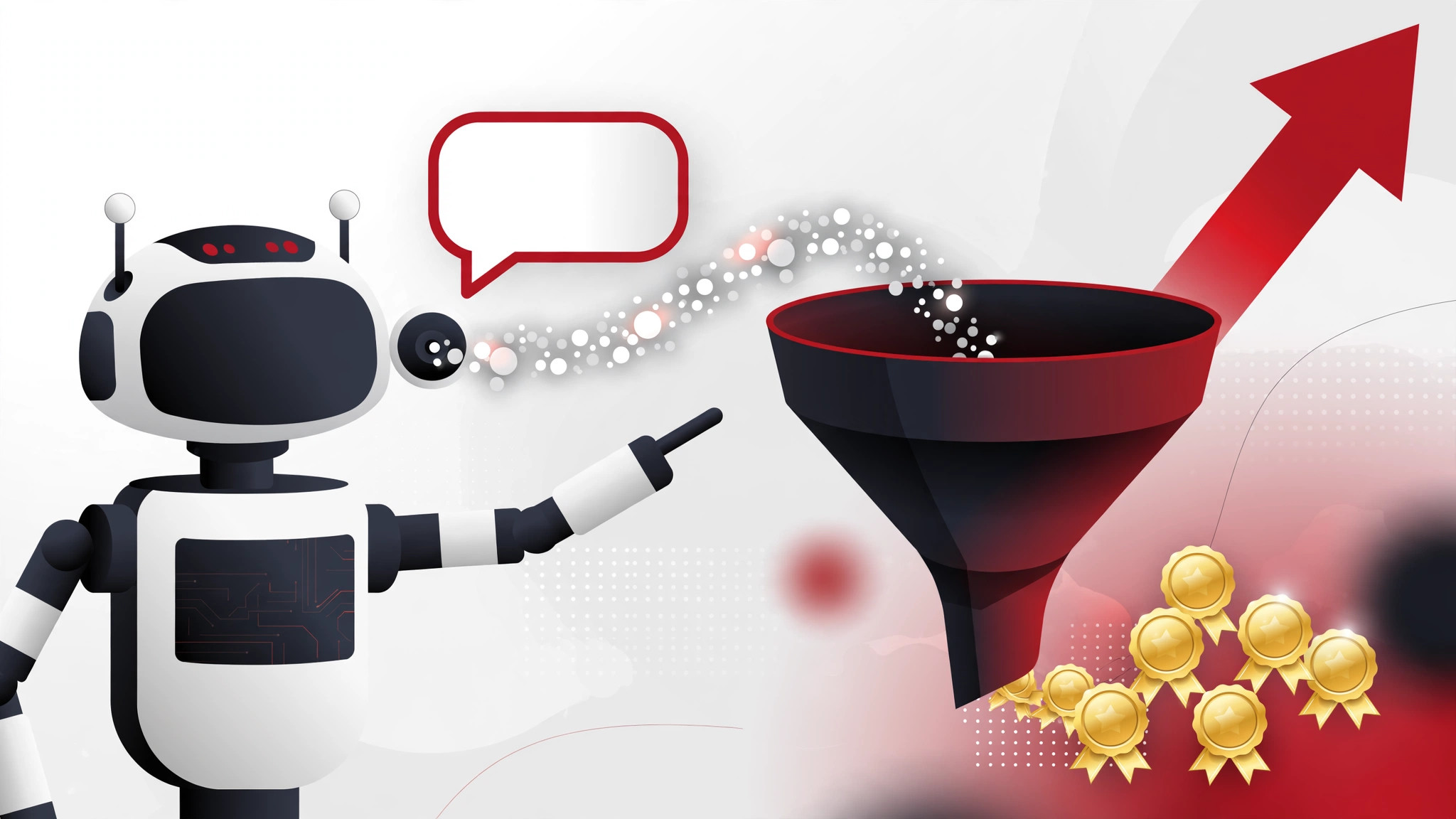
Our sales team does not use a chatbot to replace salespeople. It uses one to make sure no potential customer waits, no enquiry goes unanswered at 9pm, and no rep wastes their morning on website visitors who were never going to buy. The chatbot handles the repetitive front of the sales process; the humans handle the parts that need a human.
This article explains exactly how that division of labour works in practice: what the chatbot does, what it hands over, how it is set up, and the mistakes we learned to avoid. If you are considering a chatbot for your own sales process, this is the honest version — including what it cannot do.
What the chatbot handles: the first five minutes of every enquiry
Think about what happens when someone lands on your site with buying intent. In the old world, they fill in a contact form and wait — hours, sometimes days — for a response. By then the urgency has cooled or a competitor has replied first. The chatbot collapses that gap to zero.
Ours greets visitors, asks what they are looking for, and works through a short qualification flow: what service they need, roughly what scale, their timeline, and how to contact them. This takes about a minute and happens instantly, at any hour. A visitor browsing at 10pm gets the same immediate response as one browsing at 10am — and for many businesses, evenings and weekends are when the serious research happens.
Crucially, the chatbot also answers the repetitive questions that eat sales time: pricing guidance, service coverage, how the process works, what happens next. These are answered from a curated knowledge base, not improvised, so the information is consistent every time — no more three reps giving three different answers about pricing.
Qualification: sorting the serious from the curious
The chatbot's most valuable sales function is triage. Not every conversation deserves a salesperson's time, and salespeople are expensive. The chatbot applies consistent qualification criteria to every visitor:
- Need: What is the visitor trying to achieve, and is it something we do? Mismatches get helpful redirection rather than a sales call — better for everyone.
- Fit: Company size, location, use case — the basic facts that determine whether we can help. A two-person startup and a 500-person enterprise need different conversations.
- Urgency: When do they need this? Someone starting next month gets immediate human follow-up; someone "just researching" gets useful content and a light-touch nurture path.
- Contact: Email or phone, captured at the natural moment — when the visitor can see the benefit, such as booking a call or getting a tailored quote.
Qualified conversations are routed to the sales team instantly with a full transcript, so the rep picks up the phone already knowing the visitor's situation. Unqualified ones get a polite, helpful response and relevant resources. Either way, the visitor got an answer in seconds rather than silence.
The human handover: where the chatbot stops
The handover is the most important design decision in the whole system, and most businesses get it wrong by handing over too late or never. Our rule: the chatbot handles information and qualification; humans handle judgement, negotiation, and relationships.
Specific triggers push a conversation to a human immediately: the visitor asks for a call or demo, the question falls outside the knowledge base, the visitor expresses frustration, or the deal size signals justify personal attention. There is also always an escape hatch — "speak to a person" — visible in every conversation. Trapping visitors in a bot loop is the fastest way to destroy the trust the chatbot was meant to build.
The handover itself must be seamless. The rep receives the transcript, the qualification answers, and the visitor's contact details — so the human conversation starts where the bot left off, not with "so, what can I help you with?" repeated for the third time. Nothing annoys a buyer more than repeating themselves to three different interfaces.
Booking meetings while intent is hot
The highest-value chatbot function is meeting booking. A qualified visitor chatting at 8pm can pick a slot in a rep's calendar on the spot, get instant confirmation, and receive a reminder before the meeting. Compare that with the form-and-wait alternative: by morning, the moment has passed.
A few things make this work reliably: the calendar integration must show genuinely available slots (a booked meeting that turns out to be blocked is worse than no booking), confirmations and reminders go out automatically, and rescheduling happens through the same chat interface. We also confirm the attendee's details during booking so reps walk into calls prepared. The no-show rate on chatbot-booked meetings runs higher than human-booked ones, so the reminder sequence is not optional — it is load-bearing.
What we learned the hard way
A few honest lessons from running this in production. First, the knowledge base is everything. A chatbot with thin or outdated answers is worse than no chatbot — it confidently misleads. Ours is reviewed regularly, and every conversation the bot could not handle becomes a candidate for a new knowledge entry. The system improves because we feed it.
Second, keep the conversation short. Our qualification flow is three to five questions; every question beyond that measurably increases drop-off. If you need more detail, the human collects it later — the bot's job is to open the door, not conduct the full discovery call.
Third, measure it like a salesperson. We track conversations started, qualification rate, meetings booked, and ultimately revenue influenced — not vanity metrics like "messages exchanged". A chatbot that chats a lot but books nothing is entertainment, not sales infrastructure.
Fourth, set expectations honestly. Our chatbot does not pretend to be human. Visitors know they are talking to an automated assistant, and that honesty builds more trust than a bot clumsily impersonating a person named "Sarah". Transparency about what it can and cannot do keeps conversations in the zone where it performs well.
For businesses exploring AI more broadly in their sales process, our beginner's guide to AI sales reps covers the wider landscape — what the tools can realistically do today and where the hype outruns reality.
Is a sales chatbot right for your business?
Chatbots pay off fastest where three conditions hold: meaningful website traffic (a chatbot on a site with fifty visitors a month is decoration), a repeatable qualification process (if every enquiry is utterly unique, automation helps less), and a sales team whose time is valuable enough that filtering matters. Ecommerce, agencies, B2B services, property, automotive, education — all classic fits.
They pay off slowest where purchases are deeply consultative from the first touch, or where your buyers simply will not engage with automation. Know your audience: some demographics chat happily, others want a phone number and a human voice. The chatbot should match buyer preference, not fight it.
Done right, a sales chatbot is not a gimmick — it is the hardest-working member of the front-of-funnel team: always on, instantly responsive, perfectly consistent, and honest about its limits. Our digital marketing work often includes exactly this kind of conversion infrastructure, because traffic without a system to catch it is money wasted.
FAQs
Can a chatbot really replace a salesperson?
No — and it should not try. Chatbots excel at instant response, consistent qualification, answering common questions, and booking meetings. They cannot read a room, negotiate, handle objections with nuance, or build relationships. The winning setup is a chatbot handling the repetitive front end and humans handling everything that needs judgement.
How do you stop a sales chatbot giving wrong answers?
Ground it in a curated knowledge base rather than letting it improvise, review conversations it could not handle and add the missing answers, and design clear handover triggers for anything outside its scope. Regular review of transcripts is the maintenance that keeps answer quality high.
Will visitors get frustrated talking to a bot instead of a human?
Only if the bot wastes their time or traps them. Visitors are generally happy with fast, accurate automated help — frustration comes from bots that cannot answer, cannot hand over to a human, or pretend to be human. Always offer a visible "speak to a person" option.
What should a sales chatbot measure?
Conversations started, qualification completion rate, meetings booked, and revenue influenced — the same funnel logic as human sales. Avoid vanity metrics like message counts. The chatbot is sales infrastructure and should be judged on pipeline contribution.
How long does it take to set up a sales chatbot properly?
The technology can be live in days; doing it well takes weeks. The real work is designing the qualification flow, writing the knowledge base, integrating calendars and CRM, and testing with real conversations. Rushing this stage is why most sales chatbots underperform.
Contact us if you want a chatbot that actually contributes to your pipeline — designed around your sales process, not a generic widget.


