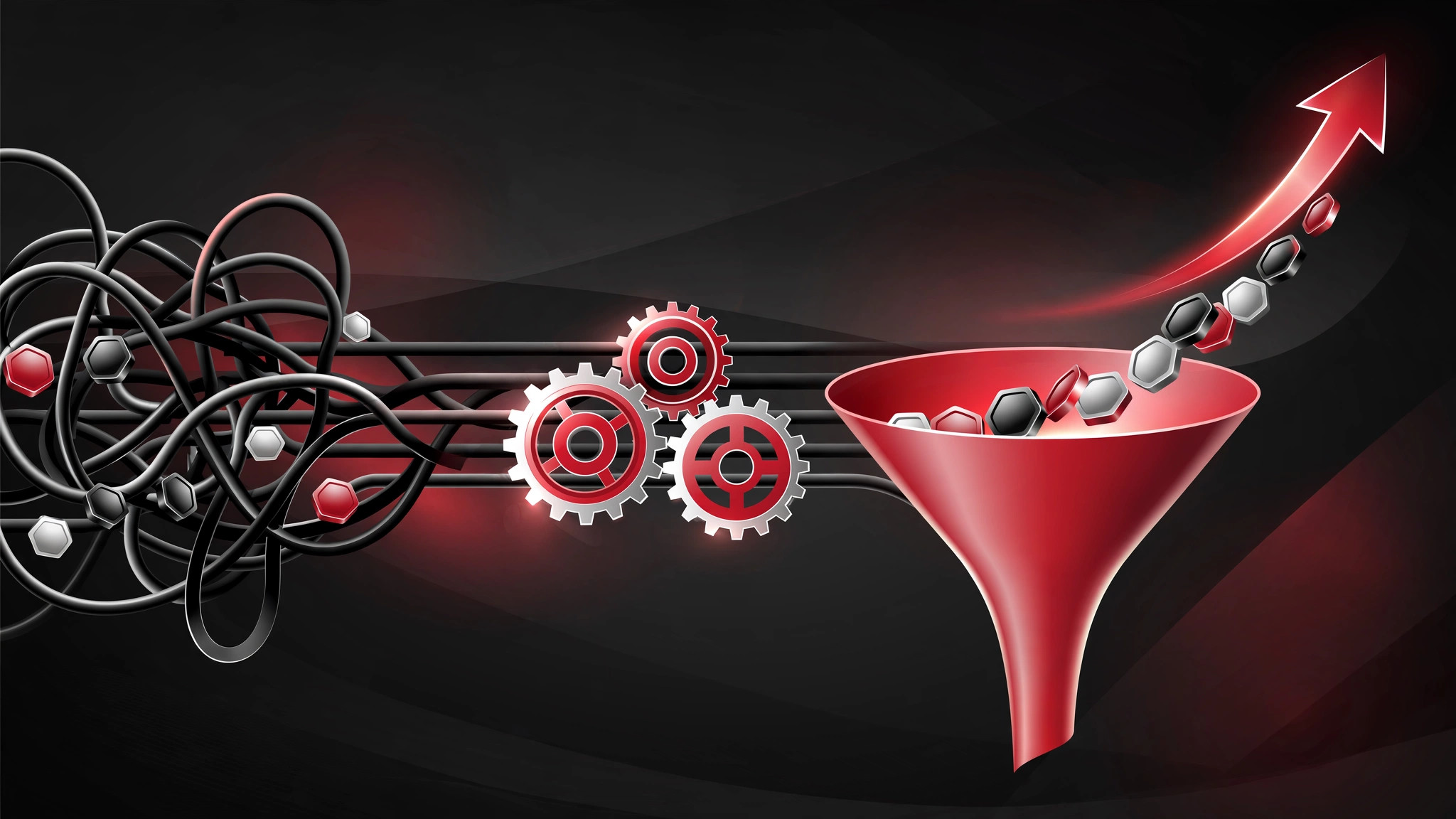
Every so often a business story circulates that's worth more than the headline. Expanish — a language school group — is reported to have streamlined its sales process and doubled its conversion rate. The headline is attractive, but the headline isn't the useful part. The useful part is the machinery underneath: what does "streamlining a sales process" actually involve, and which of those moves are the ones that produce results like that? This article breaks down the anatomy of that kind of transformation so you can apply the same thinking to your own pipeline — whether you're a school, an agency, or any business where enquiries arrive and too few of them turn into customers.
What "streamlined the sales process" usually means
When a business reports an outcome like this, the story behind it is almost never one dramatic change. It's a set of unglamorous fixes, each removing friction at a different stage of the funnel. Enquiries that used to sit unanswered for a day get answered in minutes. Follow-ups that depended on one person's memory become automated sequences. Prospects who received the same generic pitch get responses shaped by what they actually asked about. None of this is exotic. What makes it transformative is doing all of it at once, so the cumulative effect compounds.
The first step is usually visibility: getting every enquiry, from every channel — website forms, email, phone, social messages, walk-ins — into one place. Businesses are often shocked to discover how many enquiries were quietly falling through the cracks. A school taking bookings by phone, email, and Instagram DMs has three inboxes and no single record of who was promised what. Consolidating that into a proper CRM pipeline is the foundation everything else stands on.
The follow-up problem (and why it's usually the biggest lever)
In our experience, the single largest cause of lost conversions is slow or inconsistent follow-up. Research on lead response has consistently shown that contacting a prospect within minutes rather than hours dramatically increases the chance of a conversation — and most businesses are nowhere near that. Enquiries get answered "when someone has a moment", which means hours later, or the next day, or never.
This is typically where automation earns its keep. An instant acknowledgement message, a structured follow-up sequence over the following days, and automatic reminders to the salesperson before a lead goes cold — these are standard CRM capabilities, not cutting-edge AI. Our CRM development work keeps returning to this pattern: the technology is the easy part; the discipline of defining what happens at each stage, and making it happen the same way every time, is the actual transformation.
Qualification: selling to the right people, faster
Doubling a conversion rate doesn't have to mean converting the same traffic twice as well — it can also mean spending sales time on better prospects. Streamlined processes usually include a qualification stage: a few structured questions (budget, timeline, intent, fit) asked early, so salespeople stop spending an hour on a call with someone who was never going to buy.
For a language school, that might mean knowing before the consultation whether the student needs a visa-supporting course, what their start date is, and what level they're at. For your business, the questions differ but the principle holds: the earlier you identify your real buyers, the more of your sales capacity goes to them, and the higher your conversion rate climbs. This is also where lead scoring comes in — ranking prospects by behaviour (pages visited, emails opened, forms completed) so the hottest leads get human attention first.
Consistency across the team
Growth breaks sales processes. What works when the founder handles every enquiry personally collapses when three people are selling, each with their own method. Streamlining usually involves standardising: defined pipeline stages everyone uses, scripts and templates for the common conversations, and a shared definition of what counts as a qualified lead versus a closed deal.
This feels bureaucratic, and salespeople often resist it at first. But the payoff is twofold: new hires become productive in weeks instead of months, and the business stops depending on any one person's habits. When a key salesperson leaves — and they do — the process stays. That's the difference between a sales team and a collection of individuals who happen to sell.
Measuring what actually changed
Here's where many "doubled our conversion rate" stories get fuzzy, and where you should be rigorous with your own business. Conversion rate of what, exactly? Enquiry to consultation? Consultation to enrolment? Website visitor to paying customer? A business can "double its conversion rate" at one stage while the overall funnel barely moves, if the earlier stages shrank.
The honest version of this story tracks the full funnel: traffic, enquiries, qualified leads, proposals or consultations, and closed deals — measured the same way before and after. If you're embarking on your own streamlining project, set that baseline first. It's the only way to know whether the investment worked, and it keeps everyone honest about which changes did the heavy lifting. We go deeper on this discipline in our practical guide to AI sales forecasting for SMBs, which is really a guide to knowing your numbers.
What to steal from this, whatever you sell
- Centralise every enquiry channel into one CRM pipeline — you can't fix leaks you can't see.
- Get first response time under five minutes, even if the first response is automated acknowledgement.
- Build follow-up sequences so no lead depends on one person's memory.
- Qualify early with structured questions; stop spending sales hours on non-buyers.
- Standardise pipeline stages, templates, and definitions across the team.
- Measure the full funnel before and after, not just the headline stage.
None of these is a secret. The reason stories like Expanish's get told is that so few businesses actually do all six, consistently, at the same time. The technology to do it — a well-configured CRM, some automation, clear process design — has never been more accessible. The scarce ingredient is the decision to treat the sales process as something to engineer rather than something that just happens.
FAQs
Did Expanish really double their conversion rate?
That's the reported outcome. As with any business story, the valuable part isn't the headline number — it's the underlying changes (centralised enquiries, faster follow-up, qualification, standardised process) that produce results of that kind. We focus on the mechanics because the mechanics are what you can replicate.
What's the first thing to fix in a leaky sales process?
Usually follow-up speed and consistency. Most businesses lose more deals to slow responses and forgotten follow-ups than to any other single cause. An instant acknowledgement plus a structured follow-up sequence is the highest-return first move for most teams.
Do we need a CRM to streamline our sales process?
In practice, yes — once you have more than a handful of enquiries a week or more than one person selling. Spreadsheets and inboxes work until they don't, and the moment they don't is the moment leads start disappearing. A CRM is the system of record that makes every other improvement possible.
How long does a sales process overhaul take?
A focused project typically takes 4–8 weeks: mapping the current process, configuring the CRM and automations, training the team, and then a bedding-in period where you watch the numbers. The technology can be set up in days; getting the team to actually use it consistently is what takes the time.
Will streamlining help if our problem is not enough leads?
It helps twice over. First, you convert more of the leads you already have, which lowers your cost per customer. Second, knowing your true conversion rate tells you exactly how many leads you need to hit your targets — which makes your marketing spend far more efficient. Fixing the funnel before scaling traffic is almost always the right order.
If your sales process feels like it's held together with spreadsheets and good intentions, that's exactly the kind of problem we solve. Our CRM development team designs pipelines, automation, and reporting around how your team actually sells — and our conversion rate optimisation work tackles the other end of the funnel. Talk to us about where your process is leaking.


