VISUOSOFTS · AUGMENTED REALITY
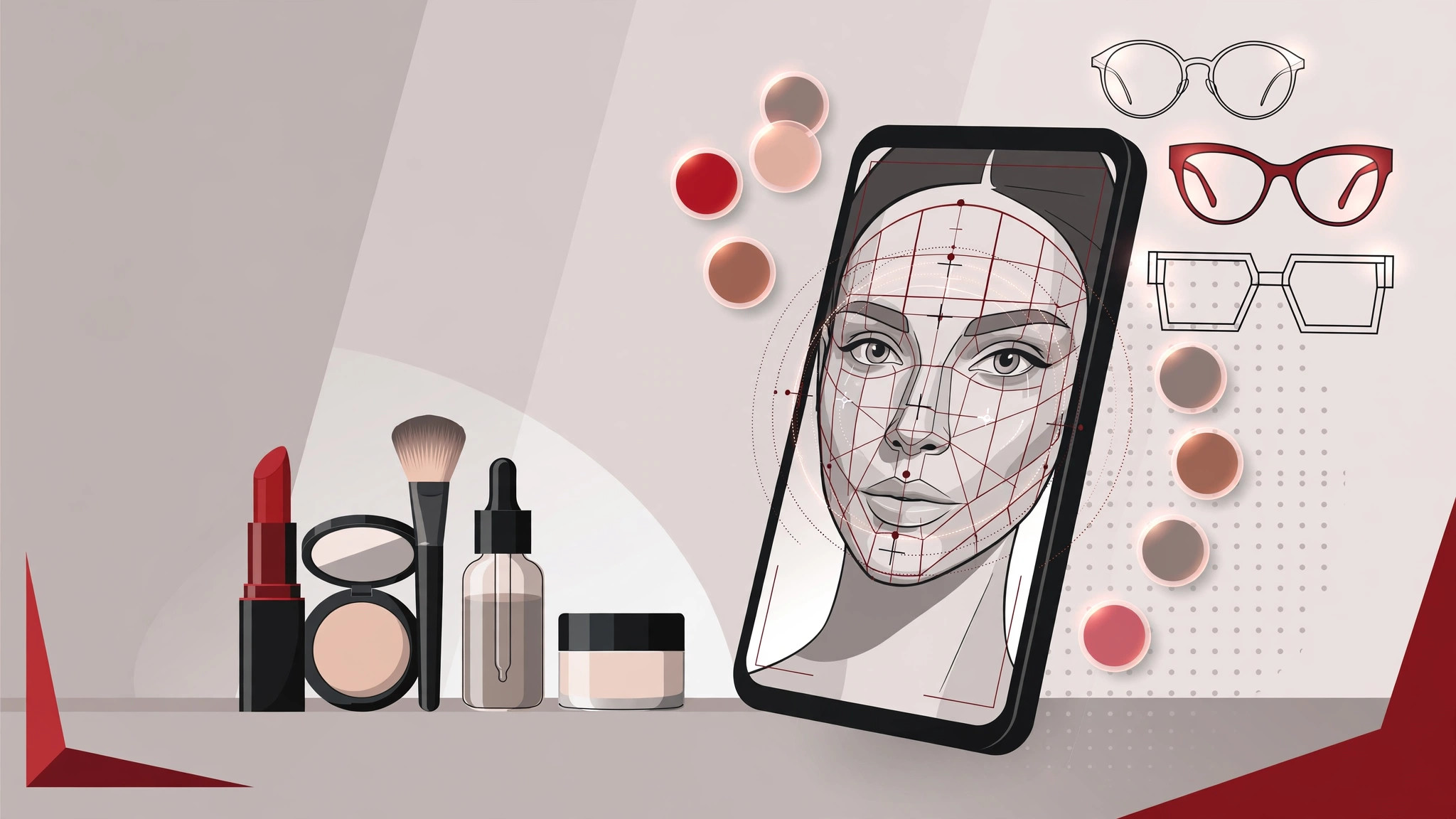
Kuwaiti fashion and beauty shoppers buy with their eyes — and their biggest hesitation online is the oldest one in retail: "will it suit me?" AR try-on answers it inside the phone. Virtual makeup shades on a real face, abaya drapes visualised, eyewear fitted to facial shape, hair colour previewed before the salon appointment. For Kuwait's mobile-first, social-commerce-driven market, try-on is not a gimmick; it is the missing fitting room.
This guide covers AR try-on for Kuwaiti fashion and beauty retailers: which product categories it actually lifts, the technology options from filters to full virtual try-on, realistic costs and timelines, and how to launch it without a failed tech experiment. We have delivered 200+ AR projects — talk to us about try-on for your catalogue.
WHERE VIRTUAL TRY-ON ACTUALLY PAYS
Try-on technology works brilliantly for some categories and pointlessly for others. The winners: beauty and cosmetics (lipstick, eyeshadow, foundation shades on the customer's real face — the highest-ROI try-on category globally), eyewear (frame fit to facial geometry), watches and jewellery (wrist and hand visualisation), and hair colour (the salon consultation use case). Strong emerging use: modest fashion — visualising abaya cuts, hijab styles, and drape on different body shapes addresses the exact hesitation that stops online modest-fashion purchases.
The weak fits: fitted garments with complex sizing (AR shows drape, not fit — it reduces but does not eliminate size returns), footwear (technically possible, lower purchase-hesitation value), and anything where texture and fabric hand-feel drive the decision. Be honest about your category before investing: try-on is a hesitation-killer, so map your top three purchase hesitations first. If "will it suit me" is not among them, your AR budget belongs elsewhere — perhaps product visualisation or better photography.
TECHNOLOGY OPTIONS: FROM FILTERS TO FULL TRY-ON
Three tiers. Tier one: social AR filters (Instagram, TikTok, Snapchat) — branded try-on effects customers use in the apps they already open. Fast to build, cheap to distribute, excellent for beauty shades and eyewear, and they double as marketing — every share is an ad. Tier two: WebAR try-on embedded in your store — no app download, works in the mobile browser, deeper integration with your catalogue and checkout. Higher build cost, higher conversion impact, and you own the experience.
Tier three: native app try-on with advanced features — body tracking, multi-product looks, save-and-share. The most capable and the most expensive, justified only for brands with serious app traffic. For most Kuwaiti retailers, the right sequence is filters first (prove demand, generate content), then WebAR on the money pages (convert the demand), and native only if the app economics support it. All three need proper 3D product assets — factor asset production (3D modelling of your SKUs) into the budget, because the try-on is only as good as the models.
WHY THE KUWAITI MARKET FITS TRY-ON UNUSUALLY WELL
Four local factors stack in try-on's favour. First, mobile-first shopping (around 70% of online sales on phones) means the camera is already in the customer's hand — no behaviour change required. Second, social commerce dominance means try-on content is natively shareable: a customer trying shades in your filter and posting it is distribution you cannot buy. Third, the beauty and modest-fashion categories that try-on serves best are core Kuwaiti retail strengths.
Fourth, cultural fit: virtual try-on lets customers experiment privately — trying bold makeup shades or new abaya styles without a shop assistant watching — which suits shoppers who value privacy in their experimentation. Add the gifting economy (Eid, National Day, weddings) where buyers purchase for others and cannot try items themselves — "see it on a model like her" becomes a genuinely useful feature. Launch timing around Ramadan/Eid and National Day (Feb 25–26) captures the gift-buying peaks when hesitation is highest.
LAUNCHING IT RIGHT: THE ANTI-FAILURE CHECKLIST
Most failed retail AR projects fail the same way: technology chosen before the use case, launched quietly, and measured never. The checklist that prevents it: start with one hero category (your highest-hesitation, highest-margin line), not the whole catalogue; build the 3D assets to a quality bar — a janky lipstick render destroys more trust than no try-on at all; integrate the call-to-action (try → add to bag must be one tap, not a treasure hunt); and launch it loudly — influencer seeding, in-store QR codes, WhatsApp broadcast to your customer list.
Staff training matters for omnichannel retailers: shop assistants in Salmiya and Kuwait City should demo the try-on to in-store customers, turning the physical visit into a digital relationship. And localise the experience — Arabic UI, Kuwaiti model diversity in any avatar-based try-on, and shade ranges that reflect the market's actual skin tones. A try-on featuring only Western model presets will be read, correctly, as a product not built for Kuwait.
MEASURING THE LIFT: WHAT GOOD LOOKS LIKE
Measure try-on like a conversion feature, not a marketing campaign. The metrics: try-on engagement rate (what share of product-page visitors try), try-to-bag rate (what share of triers add to cart), conversion lift versus non-triers, and — the money metric — return-rate reduction on try-on-assisted orders. Retailers globally report meaningful return reductions from beauty and eyewear try-on; your Kuwaiti numbers will vary by category, but the direction is consistent.
Run it as a controlled comparison: try-on live on half your hero SKUs, holdout on the other half, and read the difference after meaningful traffic. Track secondary effects too — time on page, share rate of try-on content, and the customer-service load (good try-on visibly reduces "will this suit me" DMs). If the numbers work on the hero category, expand deliberately: next category, then the next. AR try-on compounds — each category's assets and learnings make the next one cheaper.
AR TRY-ON FOR KUWAIT RETAIL — FAQs
How much does AR try-on cost to build?
It ranges widely: a social filter for one product line is a small project; WebAR try-on across a catalogue with 3D asset production is a serious build. The honest answer depends on SKU count, asset complexity, and platform — get a scoped quote rather than budgeting from averages. We quote fixed-scope AR projects; ask us.
Do customers need to download an app?
Not for filters (they run in Instagram/TikTok/Snapchat) or WebAR (runs in the mobile browser). Only native-app try-on needs a download — which is why we recommend proving demand with the no-download options first.
Which beauty products work best?
Colour cosmetics — lipstick, eyeshadow, blush, foundation shade matching — because the hesitation is purely visual and AR answers it completely. Skincare (texture, results over time) is a weaker fit.
Can try-on work for abayas and hijabs?
Yes — drape and style visualisation on different body shapes addresses real purchase hesitation in modest fashion. It shows style, not precise fit, so pair it with a good size guide and easy returns.
How long does a try-on project take?
A single-category filter can launch in weeks; full WebAR try-on with 3D asset production for a catalogue takes longer. Asset production is usually the critical path — start it early.


