VISUOSOFTS · WEB DEVELOPMENT
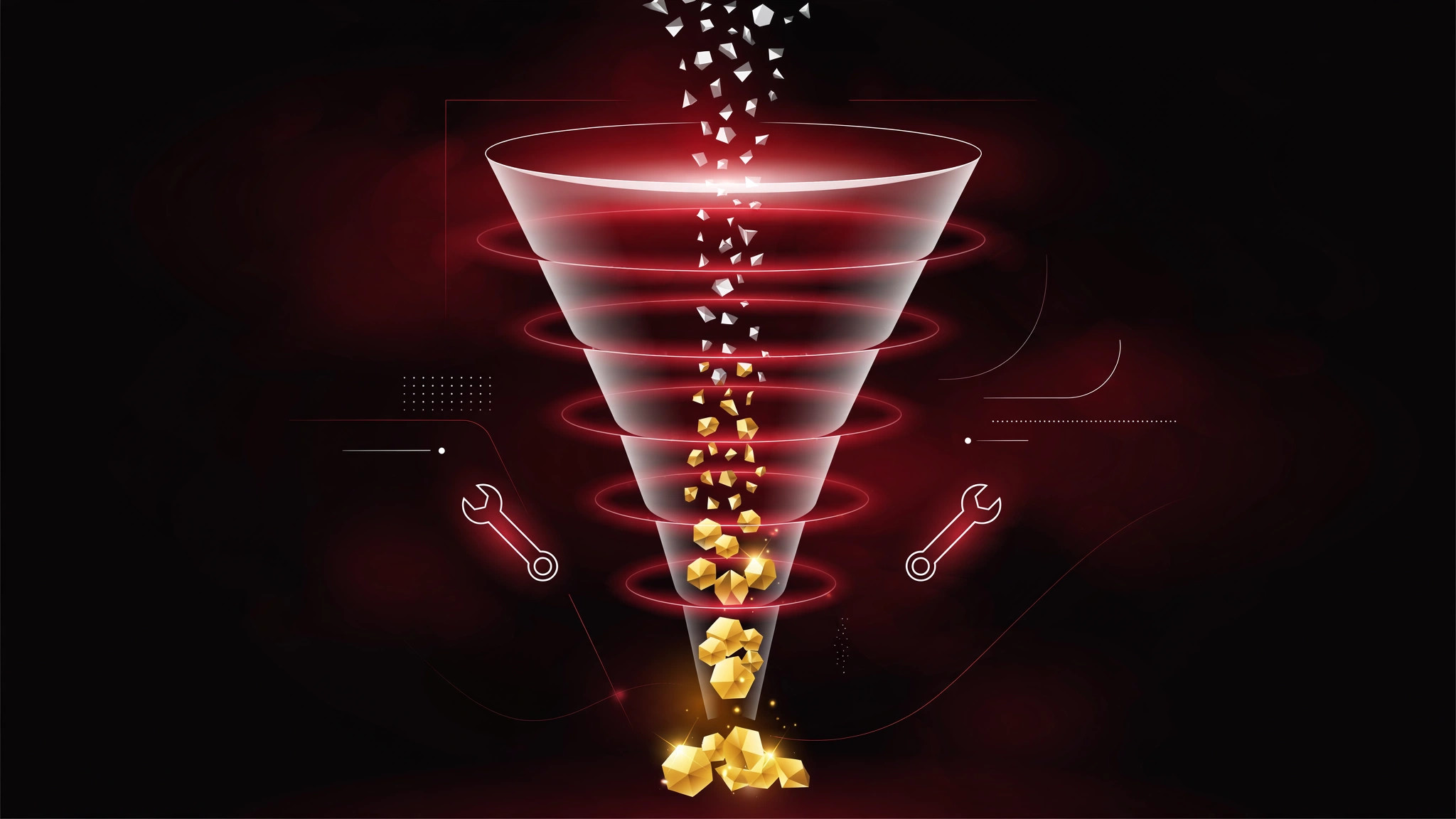
Your conversion funnel is where marketing spend becomes revenue — or does not. For SMBs, small leaks compound brutally: a 10% improvement at each of three stages nearly doubles overall conversion. These five smart ways to optimise your funnel target the leaks that matter most, in the order that pays back fastest.
Practical, sequenced, and built for teams without a dedicated CRO department.
WAY 1 — FIX THE OFFER-TO-AD MATCH
The most common funnel leak is a mismatch between what the ad promised and what the landing page delivers. The ad says "free audit"; the page talks about the company history. The ad targets manufacturers; the page speaks to everyone. Every mismatch forces the visitor to work out whether they are in the right place — and most will not bother.
Audit every entry point against its traffic source: does the headline continue the ad's promise, is the offer identical, does the page speak to the same audience? Dedicated landing pages per campaign beat generic pages every time — one offer, one audience, one action. This single fix often lifts conversion 20–30% because it repairs the break at the funnel's widest point. Our conversion rate optimisation audits start here without exception.
WAY 2 — REMOVE FRICTION RUTHLESSLY
Friction is everything between the visitor's intent and the conversion action: long forms, forced account creation, slow pages, confusing navigation, unclear next steps. Walk your own funnel as a stranger — on mobile, on a train, distracted — and count the moments of effort or confusion. Each one is a leak.
The highest-ROI friction removals: cut form fields to the minimum (every field costs conversions — ask only what you need to start the conversation), make the call-to-action unmissable and singular (one page, one action), and fix page speed (each second of load time costs conversions measurably). Also remove the "clever" — the auto-playing video, the pop-up on entry, the chatbot that opens itself. For the UX principles behind this, see improving user experience.
WAY 3 — ADD PROOF AT THE POINTS OF DOUBT
Visitors do not convert when doubt exceeds desire. Map where doubt peaks in your funnel — usually at the form (is this legitimate? what happens next?) and at the commitment (will this work for me?) — and place proof exactly there: testimonials adjacent to the form, client logos near the headline, specific results near the offer, guarantees that de-risk the decision.
Proof must be specific to persuade: "we helped 40+ manufacturers" beats "trusted by businesses"; a named testimonial with a concrete outcome beats a star rating. And keep it honest — the playbook's rule stands: no invented reviews, no fake numbers. Real proof, placed at doubt points, is the highest-leverage content in the funnel.
WAY 4 — RECOVER THE ABANDONERS
Most funnel exits are not rejections — they are interruptions, distractions and "I'll do it later". Recovery systems capture this lost intent: exit-intent offers for the hesitant, abandoned-form follow-up emails for the interrupted, retargeting for the distracted. Each recovers a slice of the 95%+ who leave — and the slices compound.
Build recovery in layers: immediate (the exit offer or saved-progress prompt), short-term (email follow-up within 24 hours for identified abandoners), and medium-term (retargeting over 30 days with proof-led creative). Measure recovery as its own funnel stage with its own conversion rate — it is usually the cheapest conversion improvement available, because the intent was already created. You paid for the visit; recovery collects what you already earned.
WAY 5 — SPEED UP THE SLOW PARTS
Funnels leak over time as well as through friction: the quote that takes a week, the callback promised tomorrow, the proposal "in progress" for a fortnight. Every delay is decay — intent cools, competitors intervene, priorities shift. Audit your funnel for time: how long from enquiry to first response, from response to quote, from quote to follow-up?
Set speed standards and automate their enforcement: 15-minute first response, 24-hour quotes, 48-hour proposal follow-up — with alerts when standards slip. The businesses with the fastest funnels win disproportionate share, because speed is experienced as competence and care. This is often an operations fix wearing a marketing costume — and it is usually the cheapest of the five.
MEASURE THE FUNNEL — STAGE BY STAGE
You cannot optimise what you do not measure. Instrument each stage: visitor to engaged, engaged to lead, lead to qualified, qualified to customer — with the conversion rate and the absolute numbers at each step. The stage with the worst rate relative to benchmark is where the next optimisation goes; fix it, re-measure, move to the next.
Review monthly, test one change at a time, and keep a changelog of what was tried and what happened. Funnel optimisation compounds: 10% here, 15% there, and within two quarters the same traffic produces dramatically more customers. Talk to us and we will audit your funnel stage by stage and sequence the fixes by payback.
CONVERSION FUNNEL OPTIMISATION — FAQs
Where should we start optimising?
At the widest leak with the cheapest fix — usually the landing page match (way 1) or form friction (way 2). Measure stage conversion rates first; the numbers tell you where to start. Never start with the checkout before fixing the landing page.
How much can funnel optimisation improve conversion?
Doubling overall conversion within two quarters is a realistic outcome for funnels that have never been optimised — through compounded stage improvements, not one big win. Mature funnels improve in smaller increments; the method is the same.
Do we need A/B testing software?
For high-traffic funnels, yes — proper testing beats opinion. For lower traffic, disciplined before-and-after measurement with adequate run times works. Do not test without enough volume to reach conclusions; inconclusive tests waste time and teach nothing.
What is the biggest funnel mistake SMBs make?
Optimising the bottom before fixing the top — perfecting the checkout while the landing page leaks 90% of visitors. Work the funnel top-down: fix entry match and friction first, then proof, then recovery, then speed.
How long before we see results?
Individual fixes show in weeks; the compounded programme shows in quarters. Treat it as an ongoing discipline — monthly review, continuous testing — not a one-off project. Funnels decay as markets and behaviours change.


