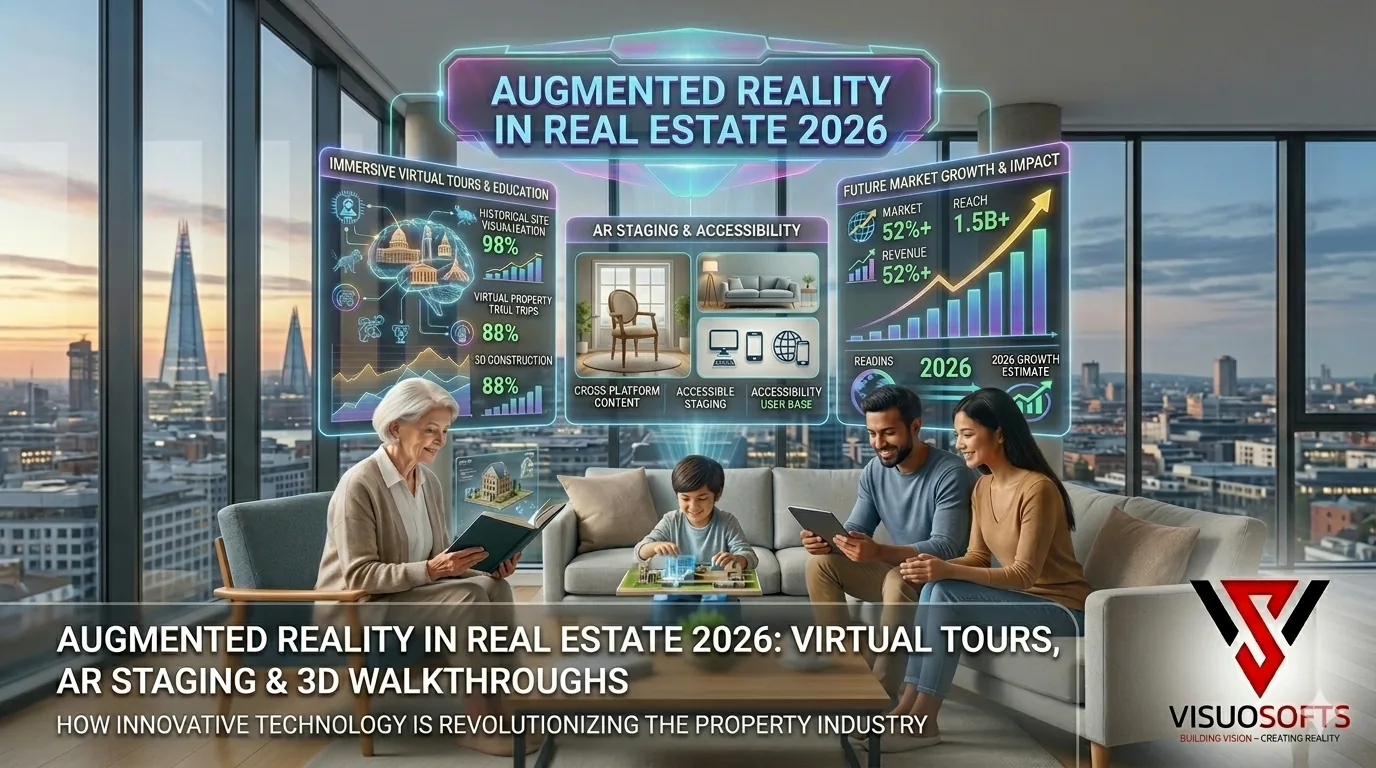
Looking for augmented reality commercial real estate? Imagine a buyer in Dubai walking through a Manchester flat at midnight, furnishing an empty living room with a tap, and making an offer before breakfast — without ever booking a viewing. That is augmented reality in real estate in 2026, and the agents who use it say the pattern is consistent: serious buyers arrive better informed, weak-fit viewings fall away, and well-presented listings move with less friction.
What Is Augmented Reality in Real Estate?
Augmented reality in real estate is the use of AR technology to layer digital content — 3D furniture, interactive floor plans, renovation previews, or entire unbuilt developments — directly onto a real or photographed space, viewed through a smartphone, tablet, or AR headset. Unlike a flat photo or a 2D floor plan, AR lets a buyer see a property as it could be, positioned within the real world at true scale and in real time.
The practical magic is simple. A buyer points their phone at an empty room and watches it fill with a sofa, a dining table, and artwork they can reposition with a tap. A developer's brochure comes alive: scan the page and a full 3D model of the building rises from it. A renovator stands in a tired kitchen and previews three different finishes in seconds. The physical space stays exactly as it is — augmented reality simply adds a responsive digital layer on top of it.
This matters because property is the most emotional, high-stakes purchase most people ever make, and the single biggest barrier to a sale is helping a buyer imagine themselves living there. Static photography and even professional video only go so far; they show a property as it is, not as it could be for that specific buyer. AR removes that barrier by handing the buyer the controls. They decide where the sofa goes, what colour the walls are, and how the light falls — and in doing so they form an emotional connection that flat media cannot create.
Augmented reality is also remarkably accessible. Unlike virtual reality, it requires no headset or specialist equipment: the overwhelming majority of AR experiences run on a smartphone the buyer already owns. For an estate agency, a developer, or a property marketer, that means your entire audience is already carrying an AR-ready device in their pocket. The barrier to adoption that held immersive technology back for a decade has effectively disappeared.
How AR Works in Property Marketing
Understanding the mechanics removes the sense of magic and replaces it with something more useful: a clear picture of what is possible, what it costs, and how simple or complex each option is to implement. AR property experiences are typically delivered through one of three trigger methods.
Marker-based AR
A specific image acts as the trigger — a brochure page, a floor plan, a printed advert, or a for-sale board. When the buyer scans it with an AR app or browser, the digital content (a 3D model of the building, a furnished room, or an animated walkthrough) appears anchored to that image. Marker-based AR is reliable, predictable, and ideal for printed marketing materials.
Markerless (surface) AR
The device's camera detects flat surfaces — a floor, a wall, a worktop — and places digital objects onto them without needing a printed marker. This is the technology behind AR furniture staging: the buyer stands in an empty room, the app recognises the floor, and a sofa appears at true scale exactly where they point. Markerless AR is the most flexible option for on-site visualisation.
Location-based AR
GPS and spatial data unlock content tied to a physical location. A buyer walking past a development site can point their phone at an empty plot and see the finished building rendered in place, or receive overlaid information about nearby schools, transport links, and amenities. Location-based AR is particularly powerful for off-plan sales and area marketing.
WebAR: the accessibility breakthrough
Layered across all three methods is the single most important development for property marketers: WebAR. Instead of forcing a buyer to download an app, WebAR runs the entire experience inside the mobile browser. The buyer scans a QR code on a brochure, listing, or board, and the AR tour opens instantly in Chrome or Safari. No app store, no friction, no lost leads. Because the biggest reason buyers abandon AR is the download requirement, WebAR routinely doubles or triples engagement compared with app-based experiences — and it is the approach we recommend for the vast majority of listings.
AR vs VR in Real Estate: What's the Difference?
The terms augmented reality and virtual reality are often used interchangeably, but they solve different problems. Choosing the wrong one wastes budget; choosing the right one for each listing maximises impact. Here is how they compare.
| Augmented Reality (AR) | Virtual Reality (VR) | |
|---|---|---|
| Experience | Digital content added on top of the real world | A fully simulated digital environment |
| Hardware | Smartphone or tablet (no headset) | Usually a VR headset |
| Best for | On-site staging, furniture preview, renovations, brochures | Fully remote, immersive walkthroughs of distant properties |
| Accessibility | Very high — runs on devices buyers already own | Lower — requires a headset for full immersion |
| Typical cost | Lower — especially with WebAR | Higher — modelling plus hardware |
In practice, the smartest agencies use both: VR-style 3D walkthroughs for remote and international buyers, and AR for staging and on-site visualisation. They are complementary, not competing. If you want a deeper primer on the underlying technology, see our guide to the best augmented reality apps in 2026.
7 Ways Estate Agents Use AR in 2026
Augmented reality is no longer a gimmick reserved for luxury developments. Across the UK and beyond, agencies of every size are using it in practical, revenue-generating ways. Here are the seven highest-impact applications.
1. AR virtual staging
Furnish empty properties digitally. Buyers point their phone at a bare room and see it staged with furniture at true scale — at a fraction of the cost of physical staging, which can run into thousands of pounds per property. Empty rooms feel smaller and colder; AR staging fixes both, instantly and reversibly. A single empty flat can be shown in contemporary, family, or minimalist styles to match each buyer.
2. Off-plan & new-build visualisation
Sell developments before a brick is laid. Buyers walk an empty plot and see the finished building rendered in place, or scan a brochure to watch a full 3D model rise from the page. For developers, this dramatically shortens the gap between launch and reservations — buyers commit to something they can finally see and explore rather than imagine from a floor plan.
3. Renovation & interior previews
Show a tired property's potential. Swap wall colours, flooring, and kitchen finishes live in AR so buyers see the upside instead of the dated reality. This is especially powerful for properties that need work — instead of writing off a buyer at the door, you let them see the dream version before the asking-price conversation.
4. WebAR brochures & for-sale boards
A QR code on a printed brochure or board launches an AR tour in the browser — no app needed. Passers-by can explore a property from the pavement, 24 hours a day. Your for-sale board stops being a static sign and becomes a lead-generating storefront that works while your office is closed.
5. On-site information overlays
Point a phone at a building to reveal price, room dimensions, EPC rating, service charges, and local amenities floating in context — turning a self-guided viewing into a guided one. This is ideal for open-house events and for serving buyers who prefer to explore at their own pace without an agent at their shoulder.
6. Interactive AR floor plans
Turn a flat floor plan into a 3D dollhouse model the buyer can rotate, measure, and explore — far clearer than lines on paper. Buyers genuinely understand flow, scale, and how rooms connect, which reduces wasted viewings from people who realise on arrival that the layout does not suit them.
7. Reaching international & remote buyers
Let overseas and relocating buyers tour and stage a property from anywhere, at any time — expanding your buyer pool well beyond your local market. For agencies serving investor clients or relocation markets, this is the difference between a handful of local enquiries and a global audience.
The Data: Does AR Actually Sell Homes?
The evidence for immersive property marketing is unusually strong because it is tied to real transaction outcomes, not just opinion. Two independent studies of US MLS transaction data found that listings with a 3D virtual walkthrough sold up to 31% faster and for up to 9% more than comparable listings without one, according to research published by Matterport. Crucially, those studies controlled for variables such as square footage, number of bedrooms, age of property, and location — so the lift is attributable to the immersive media itself, not just to nicer homes happening to use it.
Buyer demand backs this up emphatically. A survey of 1,000 buyers and 1,000 sellers found that 92% of buyers would be more likely to buy a home if the listing included an immersive 3D tour, and nearly 80% would switch to an agent who offered one, as reported via PR Newswire. The generational split is even starker: 83% of Millennials and 94% of Gen Z said they would switch agents for immersive listings. As these groups become the dominant force in the market, immersive media shifts from a differentiator to an expectation.
Engagement metrics complete the picture. Listings with virtual tours receive around 87% more views and up to 49% more qualified leads than those with photos alone, per Matterport's industry data. And on the conversion side, retailers using AR product preview — directly comparable to AR furniture staging — have reported buyers being up to three times more likely to convert, as documented in industry analysis by YORD Studio.
Immersive Listings vs Photo-Only Listings
Measured impact of 3D/AR tours on listing performance. Sources: Matterport MLS studies; National Association of Realtors data, 2020–2026.
| Metric | Improvement with 3D/AR tour |
|---|---|
| Faster sale (days on market) | Up to 31% faster |
| Listing views | +87% |
| Qualified leads | +49% |
| Sale price uplift | Up to +9% |
Market Size and Growth
The commercial momentum behind immersive property technology is clear and accelerating. The AR/VR real estate market was projected to reach around USD 2.6 billion by 2025, a figure widely attributed to Goldman Sachs and cited across industry analyses such as YORD Studio. An estimated 1.4 million real estate agents were expected to be using immersive technology by 2025 — a figure that signals the shift from early-adopter novelty to industry standard.
Zooming out, real estate is one of the fastest-growing application areas within the broader augmented reality market, which Fortune Business Insights values at USD 140.34 billion in 2025, growing at a remarkable 35.1% CAGR through 2034. As AR hardware improves and 5G connectivity becomes ubiquitous, the cost and friction of delivering rich AR experiences continues to fall, pulling more of the property industry into the technology.
The most telling signal, though, is buyer behaviour. Property buyers increasingly expect immersive listings as standard rather than treating them as a novelty. The following figures show just how mainstream that expectation has become.
Who Benefits From AR — Agents, Sellers & Buyers
One reason augmented reality has spread so quickly through property is that it delivers value to every party in the transaction at once. It is rare for a single tool to make the agent more efficient, the seller more money, and the buyer more confident — but that is precisely what well-implemented AR does.
For estate agents
AR is, above all, a time multiplier. Self-guided AR tours and pre-qualifying 3D walkthroughs mean the buyers who do book a physical viewing are genuinely serious, cutting the number of wasted appointments that drain an agent's week. It is also a powerful instructional tool: when you sit in front of a prospective vendor and show them an immersive experience their previous agent could never offer, you win the listing. In a competitive market, the agency that demonstrates the most sophisticated marketing wins more instructions — and AR is one of the most visible ways to prove that sophistication.
For sellers
Vendors care about two things: the final price and the speed of sale. AR improves both. By presenting the property in its best possible light — fully staged, beautifully lit, and explorable around the clock — AR widens the pool of interested buyers and reduces the time the property sits on the market. Every week a home lingers unsold invites price reductions and buyer suspicion; AR helps avoid that downward spiral by generating momentum early, when a listing is freshest and most valuable.
For buyers
For buyers, AR removes anxiety from the most expensive decision of their lives. They can explore a property thoroughly before committing time to a visit, measure whether their furniture fits, test renovation ideas, and compare options side by side from their sofa. This confidence translates into stronger, faster offers — buyers who fully understand a property are far less likely to hesitate, renegotiate, or pull out late in the process. The result is a smoother transaction for everyone involved.
AR in Commercial Real Estate
While residential sales attract most of the headlines, commercial real estate is where some of the highest-value AR applications are emerging. The stakes are larger, the decisions slower, and the buyers more geographically dispersed — all of which make immersive visualisation enormously valuable.
For office and retail leasing, AR lets prospective tenants visualise an empty shell fitted out for their specific business: desks, meeting rooms, branding, and signage placed at scale before a single contractor is engaged. For industrial and logistics space, AR overlays can demonstrate racking layouts, vehicle access, and capacity planning directly on site. And for investors evaluating a portfolio remotely, AR-enabled 3D models compress what used to be a week of international travel into an afternoon of immersive review.
Developers of mixed-use schemes use AR at the planning and pre-let stage to win stakeholder buy-in, secure anchor tenants, and de-risk large projects. Being able to stand on a site and see the completed scheme — its scale, its relationship to surrounding buildings, the flow of foot traffic — is a persuasion tool that 2D renders simply cannot match. As the technology matures, expect AR to become a standard part of the commercial pitch alongside the financial model.
There is also a powerful role for AR in property management once a deal is done. Facilities teams use AR overlays to visualise hidden infrastructure — pipework, cabling, HVAC routing — directly on the wall in front of them, speeding up maintenance and reducing costly errors. Letting agents use AR to show prospective tenants how a space can be reconfigured between uses. In short, AR adds value across the entire lifecycle of a commercial asset, not just at the point of sale, which is why forward-thinking commercial agencies are investing in it as core infrastructure rather than a one-off marketing spend.
Real-world examples of AR in property
The technology is no longer theoretical. IKEA's AR app, IKEA Place, let millions of users preview furniture at scale in their own homes and reported significant uplifts in engagement and conversion — the exact mechanism behind AR virtual staging in property. Matterport's 3D digital twins have become a near-standard fixture on premium listings across the UK and US, with over 90% of immersive listings in the studies cited above relying on their technology. Major portals and national agencies now actively promote immersive tours as a headline feature, and developers from London to Dubai routinely launch off-plan schemes with AR experiences at the centre of the sales suite. The direction of travel is unmistakable: what was a luxury differentiator three years ago is fast becoming the baseline buyers expect.
Best AR Tools for Real Estate in 2026
The right tool depends on your goal, budget, and whether you want an off-the-shelf solution or a bespoke experience built around your brand. Here are the leading options.
| Tool | Best for | App needed? |
|---|---|---|
| Matterport | 3D digital-twin walkthroughs of existing properties | No (browser) |
| IKEA Place / IKEA Kreativ | AR furniture staging and visualisation | Yes |
| 8th Wall (WebAR) | Custom browser-based AR brochures & experiences | No (browser) |
| Zappar / Zapworks | Custom AR for boards, brochures & developments | Optional (WebAR) |
| Custom build (Visuosofts) | Bespoke AR staging, off-plan models & branded apps | Your choice |
Off-the-shelf tools are an excellent starting point, but they apply the same template to every agency. A custom build — particularly WebAR built around your brand, your listings, and your sales process — is what turns AR from a feature into a genuine competitive advantage.
How Much Does AR for Real Estate Cost?
Cost is the question every agent asks first, and the honest answer is that it scales with ambition. The good news is that meaningful AR is now affordable for independent agents, not just national chains. Here is a realistic breakdown.
| Option | Typical cost | Best for |
|---|---|---|
| 360°/3D tour per property | £100–£500 | Standard residential listings |
| AR furniture staging set | £500–£3,000 | Empty properties, new builds |
| Custom WebAR brochure | £2,000–£8,000 | Premium listings, marketing campaigns |
| Off-plan development model | £8,000–£15,000+ | Developers, large schemes |
When weighing these figures, remember the return. If a 3D tour helps sell a £350,000 home up to 9% higher and 31% faster, even the upper end of these costs is recovered many times over in a single transaction — in agent time saved, in reduced price reductions, and in the listings you win because you offer something competitors do not.
Challenges and Limitations
AR is powerful, but it is not a silver bullet, and a balanced view builds more trust with your clients than hype. These are the genuine limitations to plan around.
- It complements, not replaces, viewings. AR shortens and pre-qualifies the buyer journey, but most buyers still want a physical visit before committing to a major purchase. Position AR as the filter that makes those visits count.
- Quality matters enormously. A poorly modelled, laggy, or unrealistic AR experience does more harm than no AR at all. Cheap, generic assets undermine the premium impression you are trying to create.
- Content needs maintenance. Listings change, prices update, and developments evolve. AR content must be kept current or it erodes trust.
- Device variation. While most modern phones support AR, performance varies. Good WebAR builds gracefully degrade on older devices rather than failing outright.
- Education curve. Some buyers — particularly older demographics — need a gentle prompt on how to scan a QR code or use the experience. Clear, simple instructions on every touchpoint solve this.
None of these are reasons to avoid AR; they are reasons to do it properly. A well-planned, well-built, well-maintained AR strategy sidesteps every one of these pitfalls.
AR and SEO: How Immersive Content Helps You Rank
It is easy to think of AR purely as a sales tool, but it is also one of the most underrated assets in a property SEO strategy. Search engines reward content that keeps visitors engaged, and few formats hold attention like an interactive 3D experience. When a buyer spends three minutes exploring an AR tour instead of three seconds glancing at photos, the resulting signals — longer dwell time, lower bounce rate, more pages per session — tell Google your page is genuinely useful. Over time, those engagement signals compound into stronger rankings.
AR content also earns links and shares in a way static listings rarely do. An impressive immersive tour is the kind of thing buyers forward to their partner, share on social media, and mention to friends — generating the organic backlinks and brand searches that move the needle in competitive local property markets. Pairing an AR experience with a well-optimised landing page, descriptive alt text, structured data, and a fast-loading WebAR build turns a single listing into a long-term SEO asset.
There is a technical dimension too. Because AR experiences are increasingly delivered through WebAR, they live on your own website rather than a third-party portal — meaning the traffic, the engagement, and the SEO benefit accrue to your domain, not Rightmove's or Zillow's. For agencies serious about owning their audience, that is a strategic advantage worth building around. If ranking your property content is a priority, it is worth reading our wider thinking on this in The Untapped Potential of WebAR in 2026.
The takeaway is simple: AR and SEO are not separate initiatives. Done together, immersive content attracts more visitors, holds them longer, earns more links, and converts more of them into enquiries — which is exactly the virtuous cycle that drives sustainable organic growth for a property business.
How to Add AR to Your Listings: A 5-Step Plan
The Future of AR in Real Estate
The trajectory is clear: AR is moving from a marketing add-on to an embedded part of how property is bought and sold. Three trends will define the next few years.
AI-generated staging and design. Artificial intelligence is already making AR staging instant and personalised — a buyer states a style preference and the room re-furnishes itself in seconds. Combined with AR, this turns every empty property into an infinitely customisable canvas tailored to each individual viewer.
Smart glasses and hands-free AR. As lightweight AR glasses reach the consumer market, the phone-in-hand experience will give way to truly hands-free walkthroughs. Buyers will simply look at a room and see information and staging overlaid naturally, making self-guided viewings richer and more intuitive.
Persistent, shareable AR. The next generation of WebAR will let multiple people share the same AR session remotely — an agent in the office guiding a buyer abroad through the same furnished room in real time. This collapses distance entirely and makes the immersive viewing a genuinely social, collaborative event.
Agencies that build AR capability and data now will compound that advantage as these technologies mature. The cost of entry will only rise as buyer expectations climb, so the best time to start is while it is still a differentiator rather than a baseline.
How Visuosofts Builds AR for Property
At Visuosofts, we build AR property experiences as part of a complete digital strategy — combining AR development with the SEO and marketing that gets your listings seen. Estate agents and developers who work with us don't just get an AR feature; they get more views, more qualified leads, and faster sales, all measured and optimised over time.
Ready to sell properties faster with AR?
Whether you're an estate agent, developer, or property marketer — Visuosofts builds AR tours, virtual staging, and off-plan experiences that turn listings into sales.
Get a free AR property consultation →Frequently Asked Questions
What is augmented reality in real estate?
Augmented reality in real estate overlays digital content — 3D furniture, floor plans, renovation previews, or unbuilt developments — onto a real or photographed space through a smartphone or tablet. It lets buyers see a property's full potential and visualise themselves living there, which is the single biggest driver of a sale.
How does AR help sell properties faster?
AR and 3D tours pre-qualify buyers and build emotional connection before a physical visit. Independent MLS studies found listings with a 3D virtual walkthrough sold up to 31% faster and for up to 9% more, while also attracting around 87% more views and up to 49% more qualified leads.
What is the difference between AR and VR in real estate?
VR replaces your surroundings with a fully digital environment via a headset, ideal for remote immersive tours. AR keeps you in the real world and adds digital layers using a phone — for example, placing virtual furniture in a real empty room. AR is more accessible because it needs no headset.
How much does AR for real estate cost?
A simple 360 or 3D tour can cost a few hundred pounds per property. Custom AR experiences — staging, off-plan models, or WebAR brochures — typically range from £2,000 to £15,000+ depending on scope and 3D modelling required. WebAR is usually the most cost-effective entry point.
Do buyers need an app to use AR property tours?
Not with WebAR. Buyers scan a QR code on a brochure, board, or listing and the AR experience opens in Chrome or Safari — no download. Dedicated apps like IKEA Place offer richer features but require a one-time install.
The Bottom Line
Augmented reality has crossed the line from novelty to necessity in real estate. The numbers tell a consistent story: listings with immersive 3D and AR experiences sell faster, attract more views, generate more qualified leads, and frequently close at higher prices. Buyers — especially the younger generations who now dominate the market — increasingly expect immersive listings as standard and will actively switch to agents who provide them. The technology is accessible, the costs are manageable, and the return on investment is measurable in both time saved and revenue gained.
The window of competitive advantage is open now but will not stay open forever. As AR becomes the baseline expectation rather than the exception, the agencies and developers who build capability, data, and experience today will be best positioned to lead tomorrow. The smartest move is to start small — one use case, one format, one set of listings — prove the return, and scale from there. Whether you begin with AR virtual staging, WebAR brochures, or off-plan 3D models, the most important step is simply to begin while it still sets you apart.
Written by Husnain Mahavia
Founder at Visuosofts. Digital strategist and AR experience builder for estate agents, developers, and brands across the UK, Kuwait, and Pakistan. Writing about augmented reality and digital innovation since 2017.