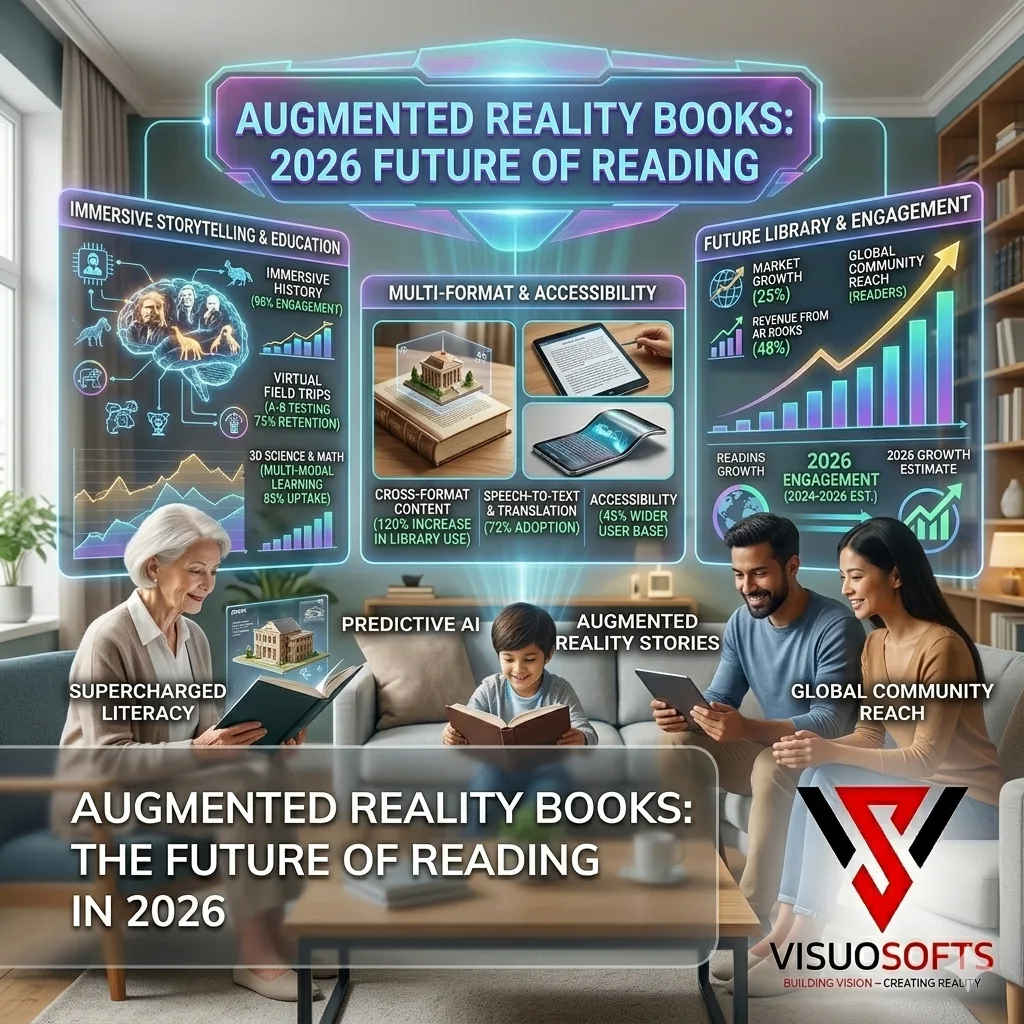
A book that makes dinosaurs walk across your kitchen table. A science textbook where the human heart beats in 3D on your desk. A children's story where characters step off the page and wave at your child. This is not science fiction — it is augmented reality books in 2026, and they are growing at 20.7% annually into a $23 billion market.

What Are Augmented Reality Books?
Augmented reality books — sometimes called a-books or AR-enhanced books — are printed or digital texts that combine traditional reading with interactive digital content accessed through a smartphone, tablet, or AR-enabled device. The physical book remains exactly as it has always been: paper, ink, illustrations, and words. But when a reader points their device's camera at a page, a digital layer appears on screen — 3D characters that move, animations that explain diagrams, audio narration, embedded video, interactive quizzes, or virtual environments that extend the story beyond the page.
Augmented reality books provide a different way to read and engage with books. They look like any paper book you would usually read, but they have digitally added features such as 3D animations, questions, quizzes, and sounds that come alive on your digital device. Th e key distinction from e-books or digital reading apps is that AR books preserve the physical reading experience — the tactile quality of turning a page, the permanence of print — while adding a dynamic digital layer that responds to the reader in real time.
This hybrid approach is why the technology has captured the attention of educators, publishers, parents, and researchers simultaneously. Unlike virtual reality, augmented reality apps do not require any headsets or other specific equipment — a smartphone is all you need to experience AR. Th at accessibility removes the primary adoption barrier: at least 87% of users interact with AR content through their smartphones. Fo r a school, a library, or a household, that means any existing device is already an AR book reader.
What an AR book experience actually looks like
How Augmented Reality Books Work
Understanding the mechanics of AR books removes the sense of magic and replaces it with something more useful: a clear picture of what is possible, what is required, and how complex or accessible implementation actually is.
The three core AR trigger methods
You can apply AR technology to any type of book using marker-based, markerless, or location-based approaches. In marker-based AR books, a specific image, sign, or code triggers the augmented experiences. Markerless AR applications work similarly, but they use invisible markers that enable AR objects to appear on the screen device via an AR app. Location-based triggers are more common for the travel industry: your physical location enables the AR experience.
| Method | How it triggers | Best for | App required? |
|---|---|---|---|
| Marker-based | Specific image or illustration on the page acts as the trigger | Children's books, textbooks with illustrations | Yes (or WebAR via QR) |
| QR code WebAR | QR code on page opens AR experience in browser | Any book type, maximum accessibility | No — browser only |
| Markerless | Device camera recognises the page by shape/texture without a visible trigger | Premium experiences, clean page design | Yes |
| Location-based | GPS position unlocks content relevant to physical location | Travel guides, history books, atlases | Yes |
What types of digital content appear in AR books
AR overlays virtual content over physical books. Learners can use an AR app or a device to scan the pages of a physical textbook to have a more engaging 3D experience. Th e specific content types that publishers embed in AR books include 3D animated characters and objects, video clips and audio narration, interactive quizzes and comprehension questions, virtual laboratory simulations, animated diagrams and process visualisations, and gamification elements such as reward systems and progress tracking. Students still confused after reading the lesson can see video examples and 3D images to better grasp the concept.
The AR Book Market in 2026: Data and Growth Trajectory
The commercial case for augmented reality books has moved firmly from speculative to established. The global augmented reality book market was valued at USD 3.56 billion in 2024 and is expected to be worth around USD 23.36 billion by 2034, growing at a CAGR of 20.7% during the forecast period from 2025 to 2034. Th at growth rate is more than double the broader publishing industry average — driven almost entirely by demand from education, children's publishing, and genre fiction.
Global AR Book Market Size 2024–2034 (USD Billions)
North America held a dominant market position in 2024, capturing more than a 40.2% share and generating USD 1.4 billion revenue. Th e US market alone is projected to reach $5.7 billion by 2034. Source: market.us / technotrenz 2025.
What is driving AR book market growth
Key reasons for adopting AR books include their ability to enhance user engagement and comprehension by supplementing static text with multimedia content that stimulates multiple senses. Publishers and content creators also benefit because AR books offer new revenue streams through interactive and differentiated products. For educators, AR books facilitate more inclusive and effective learning methods, catering to different learning styles and increasing student motivation.
Three structural trends are accelerating adoption beyond these individual benefits. First, the near-universal availability of AR-capable smartphones removes the hardware barrier that slowed AR adoption in every previous decade. Second, no-code AR creation platforms like Blippar's Blippbuilder — launched in April 2024, democratising AR content creation for mobile users and eliminating reliance on desktop software — mean that small publishers and independent authors can now add AR to their books without a development team. Third, post-pandemic normalisation of technology in education has made teachers, students, and parents significantly more open to digital-physical hybrid learning tools.
AR Book Market Share by Genre and Format (2024)
Fantasy and science fiction emerged as the leading genre, securing 35.9% share. Print + AR integration dominated the format category with 38.7% share. So urce: market.us 2025.
AR Books in Education: What the Research Actually Shows
The education sector is the primary growth engine of the AR book market — and the most thoroughly researched application of the technology. The evidence base is growing rapidly, and it tells a consistently positive story.
Researchers found that children who read an AR book did better at answering questions that required deep thinking compared to children who read the same story in a paper book. Th is finding — from peer-reviewed research published in Frontiers for Young Minds — is particularly significant because deep thinking comprehension is the metric that matters most for long-term academic outcomes. It is not enough for a child to remember what they read; they need to be able to apply, analyse, and synthesise the information. AR books measurably improve this capability.
How AR books help students with reading difficulties
One of the most significant — and often underreported — findings from AR books research concerns learners who struggle with traditional reading. Children with reading difficulties often report lower reading attitudes, motivation and interest, and higher levels of reading anxiety. AR books may be one way to support their reading practices and foster positive social reading experiences with others.
Augmented reality books focus on "doing" more than "listening," resulting in higher student success outcomes. Fo r students with dyslexia, ADHD, or other learning differences, the multi-modal nature of AR — combining visual, auditory, and interactive elements simultaneously — provides alternative pathways to comprehension that flat text simply cannot offer. A struggling reader who cannot hold the sequence of a complex diagram in memory can rotate a 3D model and zoom in on each component independently.
Student Learning Outcomes: AR Textbooks vs Traditional Books
Average measured improvement across multiple peer-reviewed studies comparing AR textbook use to equivalent traditional print instruction. Source: ResearchGate; Frontiers for Young Minds; PMC 2024; Visuosofts compiled analysis.
The updatability advantage for educational publishers
Beyond learner outcomes, AR books solve a problem that has plagued educational publishing for decades: the pace at which textbook content becomes outdated. While the printed words of the text cannot be updated, the augmented portion can. Links can be refreshed to contain more relevant information, effectively extending the book's longevity and usefulness. A biology textbook printed in 2023 still shows the correct cell diagrams — but its AR layer can be updated in 2026 to reflect new research, new examples, and new teaching methodologies, without reprinting a single page.
Augmented Reality Books for Children: Making Stories Come Alive
Children's publishing is the second-largest segment of the AR book market and, arguably, the one with the most powerful impact on a child's relationship with reading. The core challenge of early literacy has always been engagement: children must find books compelling enough to choose them over every other competing stimulus. AR books address this challenge directly.
Augmented reality transforms children's books into highly enjoyable and engaging experiences by putting characters in a three-dimensional environment. This enables children to interact with them just like in real life. Wh en a child can make a character wave back at them, follow them around the room, or unlock a hidden scene by completing a reading task, the book is no longer competing with a tablet screen — it is one.
What AR adds to children's books specifically
- Character animation: Illustrated characters walk, talk, dance, and interact with the reader in 3D — transforming the emotional connection a child forms with a story
- Sound and narration: AR layers add character voices, sound effects, and background music without requiring a separate audio device or parent to read aloud
- Gamification: Comprehension questions appear as interactive games; readers earn rewards for finishing chapters or answering correctly, building reading habit through intrinsic motivation
- Shared social reading: Most children demonstrated a desire to share their AR book reading experience with others — encouraging shared AR book reading with peers within the classroom could create novel positive social reading experiences
- Vocabulary support: Difficult words can be tapped to reveal pronunciation, definition, and a visual example — removing the barrier that causes struggling readers to disengage
Children's Reading Behaviour: Traditional Books vs AR Books
Comparison of key reading behaviour metrics across primary-age children (ages 5–11). AR books consistently improve voluntary reading time, comprehension retention, and desire to re-read. Source: PMC 2024; Frontiers for Young Minds 2025; Visuosofts analysis.
Types of Augmented Reality Books Across Genres
Apart from educational books, AR can also do wonders for children's books, atlases, travel guides, and more. He re is a breakdown of the major AR book categories and what AR specifically adds to each.
Best Augmented Reality Book Apps in 2026
Both readers and publishers need apps to experience and create AR books. Here are the leading platforms across both categories.
Quiver Education
Children colour printed templates, then bring them to life in AR — their own drawings become animated 3D characters. Also includes curriculum-aligned educational AR content for science, history, and maths. The most widely used AR book app in UK primary schools. Free core packs; premium content from £8/month for classrooms.
Merge EDU
The leading AR textbook companion for secondary science. Anatomy, chemistry, space, ecosystems — students hold a physical cube or use any surface to interact with 3D models aligned to UK and US curriculum standards. Used in 50,000+ classrooms globally.
Artivive
Artivive is the world's leading AR platform for art books and print media. Scan any artwork in a book or gallery to reveal animated digital layers created by the artist. Used in art education globally and by 50,000+ artists. Free app for readers; creator plans from €19/month for publishers.
Blippar (Blippbuilder)
Blippar launched Blippbuilder Mobile in April 2024 — a no-code AR creation platform for mobile users, democratising AR content creation on-the-go and eliminating reliance on desktop software. The pl atform allows publishers, educators, and individual authors to build AR book experiences without a development team. WebAR delivery means readers need no app — a QR code on the page opens the AR experience in any browser.
Zappar (Zapworks Studio)
Zapworks Studio is the professional-grade AR creation platform used by publishers embedding AR into high-production books. Supports image tracking, WebAR delivery, face tracking, and full 3D scene building. Used by educational publishers for AR textbook rollouts at scale. Subscription from £69/month.
How Publishers Can Create Augmented Reality Books
For publishers — from independent authors to major houses — the practical question is not whether to add AR to books, but how. Creating an augmented reality book does not differ much from creating a traditional one. Think about the content. Which parts of your text or illustrations should provide an augmented experience? Think about it beforehand so as not to damage the book's integrity.
Step-by-step: adding AR to a book
How Visuosofts Builds AR Book Experiences
At Visuosofts, AR experience development sits within our broader digital services offer — which means AR books are designed and built in the same strategic context as our SEO, content marketing, and AI automation work. Publishers, educators, and authors who work with us do not just get an AR feature; they get a complete strategy for how AR enhances the book's value, discoverability, and commercial performance.
Ready to bring your book to life with augmented reality?
Whether you are an educational publisher, an independent author, or a school looking to build AR learning materials — Visuosofts delivers full AR book experiences from concept to launch.
Get a free AR book consultation →Frequently Asked Questions: Augmented Reality Books
What are augmented reality books?
Augmented reality books are printed or digital books that have digitally added features such as 3D animations, questions, quizzes, and sounds that come alive on your digital device. The ph ysical book remains unchanged — but when a reader points a smartphone or tablet at specific pages, interactive digital content appears on screen as if it physically exists in their space. No headset is required: at least 87% of users interact with AR content through their smartphones.
Do augmented reality books help children learn better?
Yes, consistently across multiple independent studies. Researchers found that children who read an AR book did better at answering questions that required deep thinking compared to children who read the same story in a paper book. Separa tely, about 72% of students said they were more likely to participate in an AR-powered studying process. Even s hort-term use of augmented reality books increases young children's motivation for reading — a fi nding of particular significance given declining reading motivation across school years.
How big is the augmented reality book market?
The global augmented reality book market was worth USD 3.56 billion in 2024 and is expected to reach USD 23.36 billion by 2034, growing at a CAGR of 20.7%. North America holds the dominant regional position with 40.2% share and USD 1.4 billion revenue. Educat ion is the primary growth driver, followed by children's publishing and fantasy/science fiction.
Do readers need to download an app to use AR books?
Not necessarily. WebAR technology — now the recommended standard for publisher AR — requires no app download at all. A QR code printed in the book opens the AR experience directly in the reader's mobile browser (Chrome or Safari). For dedicated AR book apps like Quiver or Merge EDU, a one-time free download is required. The no-download WebAR approach removes the single biggest adoption barrier and is the approach Visuosofts recommends for all new AR book projects.
How much does it cost to add AR to a book?
Costs vary significantly by complexity and number of AR moments. A simple WebAR package for an independent author — covering 5 QR code-linked AR experiences using video and basic 3D — typically costs £2,000–£6,000. A full educational textbook AR rollout with custom 3D models, interactive simulations, and quiz functionality across 20+ AR moments typically costs £15,000–£50,000. No-code platforms like Blippar allow basic AR experiences to be self-built for a monthly platform fee of £30–£100. Visuosofts offers free consultations to scope AR book projects accurately.
Written by Husnain Mahavia
Founder at Visuosofts. Digital strategist and AR experience builder for publishers, educators, and brands across the UK, Kuwait, and Pakistan. Writing about augmented reality and digital innovation since 2017.