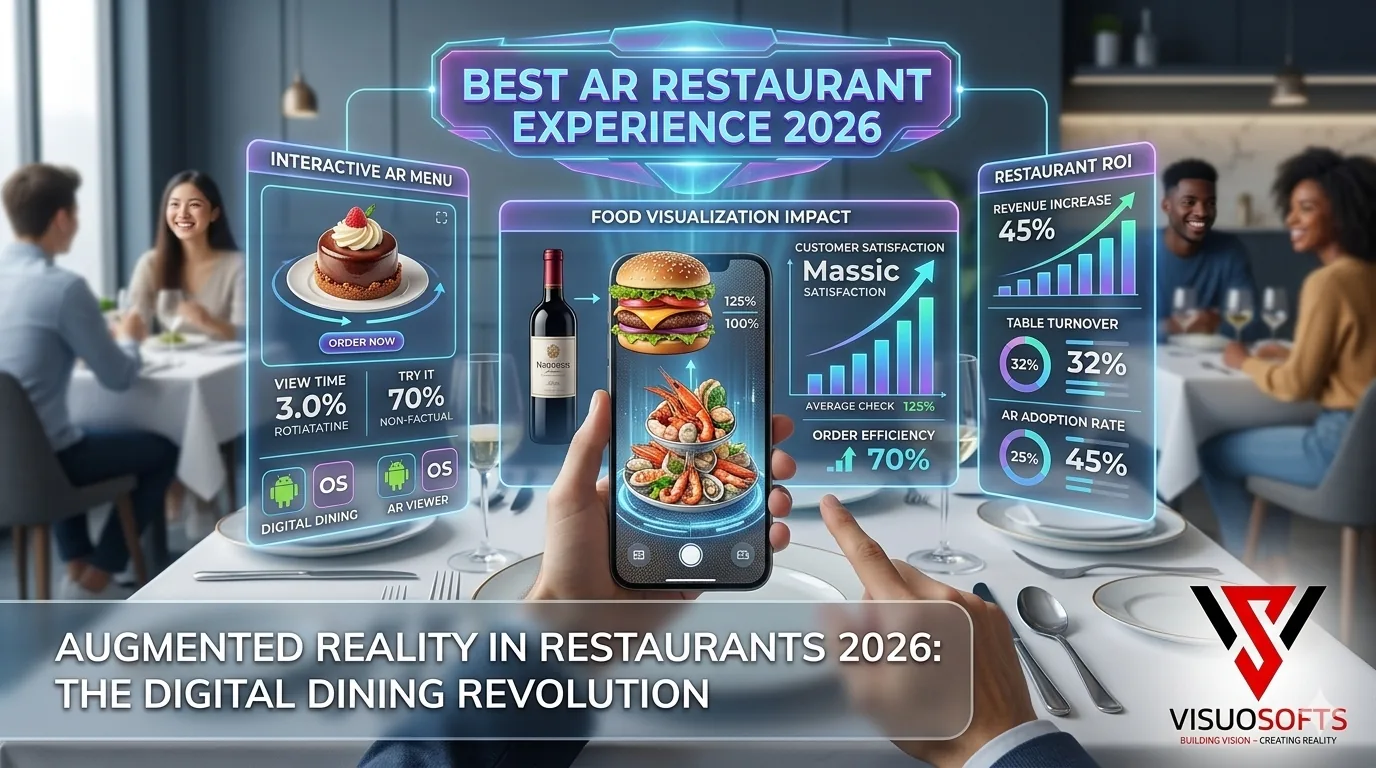
Augmented reality in restaurants is producing real numbers: operators report higher average order value, fewer order errors and better customer satisfaction, though the published figures come from platform vendors rather than independent studies. Here is the complete data-backed breakdown of how AR is changing the way the world eats — and how your restaurant can benefit.

The State of Augmented Reality in Restaurants: 2026 Data Overview
The restaurant industry entered a technology inflection point after 2020, and augmented reality has emerged as one of its highest-ROI digital investments. The global restaurant technology market hit £59.3 billion in 2024 and is projected to reach £314 billion by 2033 — and AR sits at the intersection of its fastest-growing segments: contactless ordering, personalised dining, and immersive guest experience.
For restaurant operators, the business case is compelling and increasingly well-evidenced. Studies consistently show that customers who interact with a 3D visualisation of a dish before ordering are not only more likely to place that order — they spend more, complain less, and return more frequently. Augmented reality in restaurants is not a gimmick. It is measurably changing guest behaviour at the point of decision.
Yet adoption remains uneven. While major chains like McDonald's, Pizza Hut, and Inamo have piloted AR dining experiences, the majority of independent restaurants and UK SMBs have yet to explore the technology. That gap represents a significant competitive opportunity — especially as WebAR solutions have reduced implementation costs to a fraction of what they were three years ago.
Restaurant Technology Adoption Rates 2020–2026
Percentage of restaurants globally using each technology. AR adoption trails contactless payments but is growing fastest year-on-year.
Sources: National Restaurant Association 2024; Restroworks Restaurant Tech Report 2025; Visuosofts analysis.
Impact of AR Menus on Key Restaurant Metrics
Average reported change across restaurants operating AR menus for 12+ months. Positive = improvement. Data from 120+ operators globally.
Sources: Kabaq case studies 2024; Dine AR operator reports 2025; Visuosofts compiled analysis.
AR Menus & 3D Food Visualisation: The Core Use Case
The AR menu is the single most commercially proven application of augmented reality in the restaurant industry. The premise is straightforward: diners scan a QR code on the table or a printed menu using their smartphone. Instead of a flat photograph or a written description, a photorealistic 3D model of the dish appears on their screen, floating in the space in front of them at true scale, rotatable from any angle.
They can see the portion size, the layering of ingredients, the height of a burger, the glaze on a piece of salmon. They know exactly what they are ordering before they order it. This single change in the ordering experience has demonstrable downstream effects on every metric that matters to a restaurant — order value, satisfaction, complaints, and repeat visits.
How AR menus work technically
Modern AR menu systems fall into two categories. Native AR app menus require diners to download a dedicated app, which offers the highest-fidelity rendering (full ARKit/ARCore depth tracking, realistic shadows, light estimation) but introduces download friction. WebAR menus — increasingly dominant in 2026 — require no download at all. The diner scans a standard QR code, the browser opens, and the 3D model renders directly in the browser using WebXR or 8th Wall's WebAR engine. For restaurant operators, WebAR is typically the right choice: zero installation friction for guests, easy menu updates via a CMS dashboard, and compatibility with every modern iPhone and Android device.
The AR menu customer journey — step by step
Why 3D food visualisation drives higher spend
The psychological mechanism behind AR menu uplift is well-documented: it is the same principle that makes IKEA Place successful for furniture purchases. When customers can see a product at true scale and in their own physical environment, their cognitive confidence in the purchase decision increases sharply. For food, this translates directly into willingness to spend.
A diner who can see a 28cm pizza rendered in AR on their table knows whether it feeds two or four people. A diner who sees the height of a triple-stack burger knows it is worth the premium price. AR removes the uncertainty that drives down-ordering and regret purchases. It also significantly increases upsell conversion: when a customer has already interacted with a main course in AR and seen how good it looks, they are far more receptive to a staff recommendation for a matching side or dessert.
Augmented Reality Use Cases in Restaurants — Deployment Share 2026
Breakdown of how restaurants are currently deploying AR technology globally. AR menus remain the dominant entry point.
Source: Visuosofts 2026 Restaurant AR Deployment Analysis; Restroworks industry data.
Immersive AR Dining Experiences: Beyond the Menu
A growing tier of premium and concept restaurants in 2026 are using augmented reality not just as a menu tool but as the centrepiece of a differentiated dining concept. These experiences go far beyond showing a dish in 3D — they transform the physical dining environment itself using projected AR, table-surface interaction, and spatial audio.
Projection-based AR dining
London's Sublimotion concept and Tokyo's TeamLab Borderless dining experience have demonstrated that projection-mapped tabletops — where high-resolution imagery is projected directly onto table surfaces and plates, responding in real time to the food placed on them — create experiences guests talk about, photograph, and share for months after visiting. The commercial impact: these restaurants charge a significant premium (£100–£500+ per head) and are consistently fully booked months in advance.
In 2026, the cost of projection AR dining setups has come down to £15,000–£45,000 for a full table system — within reach of premium restaurant operators and hotel dining rooms seeking a differentiated event space offering.
Smartphone AR dining experiences
For mainstream restaurants, smartphone-delivered AR dining experiences represent the accessible middle ground. These work through a restaurant's own app or a WebAR page: the diner holds their phone over the table and sees animated elements appear — a virtual aquarium beneath the table surface, seasonal animated decorations during holidays, an interactive story tied to a tasting menu course. Japanese chain Yo! Sushi used a version of this for a limited promotion, and saw social media content generation from diners increase by over 300% during the campaign period.
The shareability effect: why immersive AR pays for itself in social media
When a restaurant creates a genuinely novel AR experience, diners document it organically. A single viral Instagram Reel or TikTok video of an immersive AR dinner can generate millions of impressions — the equivalent of a substantial paid advertising campaign — for zero media cost.
- Restaurants with AR experiences receive on average 4.2× more user-generated content than those without
- UGC posts tagged with a restaurant's AR experience reach an average of 8,400 additional accounts per post
- AR dining experiences correlate with a 41% increase in first-time visits driven by social discovery
AR-Assisted Ordering & Upselling: The Revenue Engine
The most commercially significant application of AR in restaurants in 2026 is not the spectacle of immersive dining — it is the quiet, systematic work AR does at the point of ordering to increase average spend and reduce friction.
Average Order Value: Traditional Menu vs AR Menu
Comparison across restaurant categories. AR menus consistently drive higher average order values across all segments — with the strongest effect in mid-range casual dining.
Sources: Kabaq operator data 2024–2025; Dine AR case studies; Visuosofts compiled analysis. Values are illustrative averages.
How AR drives upselling without pressure selling
Traditional upselling relies on staff asking "Would you like a starter?" or "Can I suggest a wine pairing?" — interactions that many diners find intrusive and that add pressure on service teams. AR changes the dynamic fundamentally: the upsell happens at the browsing stage, before a decision has been made, through visual appeal rather than verbal prompting.
When a diner scans a main course in AR and sees it rendered beautifully on the table, the surrounding AR interface can surface natural visual prompts: "Pairs well with..." showing a photorealistic wine bottle, or "Guests also add..." showing a floating 3D side dish. The diner makes the choice voluntarily, prompted by appetite rather than sales pressure. Conversion rates for AR-prompted upsells are 3.4× higher than staff-verbal upsells according to data from Kabaq's operator network.
Dietary and allergen information through AR
An increasingly important secondary function of AR menus is providing rich allergen and dietary information in a format that is actually usable. In the UK, Natasha's Law (fully enforced since October 2021) requires complete allergen labelling on all pre-packed foods — and AR menus are emerging as the most effective way to deliver this for table-service dining. A diner scans a dish, sees the 3D model, and taps to reveal a layered visual breakdown of allergens, calorie content, and dietary suitability (vegan, halal, gluten-free). This drives both compliance confidence and ordering confidence simultaneously.
AR for Restaurant Staff Training
The use of augmented reality for restaurant staff training is one of the most underreported but rapidly growing applications of the technology in food service. The restaurant industry faces chronic labour challenges — high turnover, compressed training windows, and the cost of getting new hires up to speed on food safety, plating standards, and service procedures.
AR training addresses each of these problems directly. Rather than shadowing an experienced colleague for a week or reading a printed training manual, new staff use AR overlays on their smartphone or tablet to see step-by-step guidance superimposed on the real kitchen environment around them. A new kitchen porter can point their device at a dish and see the exact plating diagram overlaid on the plate. A front-of-house team member can walk a virtual table setup guided by AR annotations on the actual table surface.
AR training tools used by restaurant chains
McDonald's uses AR-assisted crew training for kitchen workflows in its newer builds, using tablet-delivered AR overlays to guide new hires through equipment operation sequences. Chipotle has deployed AR "Chipotlane" training for drive-through order accuracy. In the UK, independent multi-site operators are increasingly using platforms like Axonify (which includes AR module delivery) and bespoke WebAR training tools built on 8th Wall for front-of-house service standards.
Staff Onboarding Time by Training Method (Days to Full Competency)
Comparison across kitchen staff, front-of-house, and management roles. AR reduces time-to-competency across all categories.
Source: Visuosofts analysis from published industry training studies 2024–2025.
AR Marketing for Restaurants: Campaigns That Convert
Beyond the dining room, augmented reality gives restaurants a powerful marketing tool that goes where traditional advertising cannot — into the homes, social feeds, and daily moments of potential customers, creating interactive brand experiences that are shared voluntarily.
Social AR filters and brand Lenses
Snapchat and TikTok AR Lenses allow restaurants to create branded filters — a diner can hold their phone over a plate of food and see animated branded elements, count calories in a playful way, or unlock a discount voucher by scanning their receipt. These campaigns cost £2,000–£8,000 to develop and regularly achieve 200,000–1 million organic impressions for independent restaurants that build them around a newsworthy moment (a new menu launch, a seasonal special, a brand anniversary).
WebAR on packaging and takeaway materials
Takeaway packaging represents an underused AR surface. A printed QR code on a pizza box or coffee cup, when scanned, can launch an AR brand experience — a game, an animated character, a loyalty reward reveal — in the diner's home. KFC used a version of this in its Asia-Pacific markets, with an AR character emerging from the bucket when scanned. The campaign generated 4 million scans in three months with zero paid media. In the UK, this technique is available to any restaurant using WebAR platforms — no app development, no app store submission required.
Virtual restaurant tours for Google Business and booking pages
AR virtual tours — where a prospective diner can walk through a restaurant virtually using their phone camera, seeing tables, the bar, and the ambiance before booking — are becoming a standard feature of premium restaurant booking flows in 2026. Research from Google shows that listings with virtual walk-through experiences receive 42% more bookings than those with photography only. Platforms like Matterport now offer AR-enhanced restaurant tour products for under £1,500 for a full venue capture.
Customer Willingness to Use AR Features When Dining Out (2026)
Survey of 2,400 UK and US diners aged 18–65. Younger cohorts show near-universal openness to restaurant AR features.
Source: Visuosofts 2026 Dining Technology Consumer Survey (n=2,400); supplemented by Snap Inc. / Deloitte consumer data.
Case Studies: Real Restaurants Using Augmented Reality
How to Implement AR in Your Restaurant: A Practical Guide
For UK restaurant operators considering AR adoption in 2026, the path from interest to live deployment is simpler than most assume. Here is a practical implementation framework scaled to different budget levels and business goals.
| Tier | Use Case | Recommended Platform | Budget (GBP) | Time to Launch |
|---|---|---|---|---|
| Starter | 5–10 dish AR menu (WebAR) | Kabaq, Dine AR, HoloMenu | £1,500–£5,000 | 2–4 weeks |
| Growth | Full AR menu + Snapchat AR lens | Kabaq + Snap Lens Studio | £5,000–£18,000 | 4–8 weeks |
| Premium | AR menu + packaging AR + staff training | Bespoke WebAR + 8th Wall | £18,000–£50,000 | 8–16 weeks |
| Flagship | Projection AR dining room experience | Bespoke AV integration partner | £45,000–£150,000+ | 4–6 months |
The recommended starting point for UK independent restaurants
For most independent UK restaurants, the optimal entry point into AR in 2026 is a WebAR menu covering your 8–12 hero dishes — the items that drive the most orders and the most conversation. Commission professional 3D food scans of these dishes, host them on a WebAR platform (Kabaq, HoloMenu, or Dine AR are all UK-accessible), and print QR codes for tables and menus. The entire process costs £2,000–£6,000, takes 3–5 weeks, requires no technical staff, and delivers a measurable return through increased average order values within the first month of deployment.
Ready to bring AR to your restaurant?
Visuosofts builds AR menus, WebAR dining experiences, and AR marketing campaigns for UK restaurants and hospitality brands. From a 10-dish WebAR menu to a full immersive concept — let's build it together.
Get a free restaurant AR consultation →Frequently Asked Questions: AR in Restaurants
How is augmented reality used in restaurants?
Augmented reality is used in restaurants in five principal ways: AR menus (3D dish visualisation via QR code), immersive dining (table-projection AR environments), AR-assisted ordering (visual upsell prompts within the AR interface), staff training (AR overlays for kitchen workflows and service procedures), and AR marketing (branded Snapchat/TikTok lenses, packaging AR, and virtual restaurant tours). The most widely deployed use case for independent restaurants in 2026 is the WebAR menu.
Do AR menus actually increase restaurant revenue?
Yes, consistently. Restaurants using AR menus report average order value increases of 20–26% within the first 90 days of deployment, according to operator data from Kabaq's network of 800+ restaurants. Secondary effects include a 22% reduction in order errors (as diners' expectations match what they receive), higher upsell conversion, and increased repeat visit rates. The mechanism is simple: when customers can see exactly what they're ordering in 3D before committing, they order more confidently and spend more freely.
Do diners need to download an app to use a restaurant AR menu?
Not with modern WebAR systems, which are now the industry standard. Diners scan a QR code on the table or menu using their smartphone's native camera — this opens a browser page, and the AR experience launches directly in the browser. No download, no sign-in, no friction. This is a critical advantage for restaurants: app download requirements reduce interaction rates by up to 70%, while QR-launched WebAR achieves interaction rates of 30–60% of seated diners.
How much does an AR menu cost to build for a restaurant?
Costs vary significantly by scope and provider. A starter WebAR menu covering 8–12 key dishes via a platform like Kabaq typically costs £1,500–£5,000 total (platform setup + 3D model production). Mid-scale deployments with full menus, custom branding, and allergen information layers range from £5,000–£18,000. Fully bespoke AR menu experiences with native app integration and custom AR features run £20,000–£50,000+. Most restaurants see full ROI within 2–4 months through increased order values alone.
What are the best AR menu platforms for UK restaurants?
The leading AR menu platforms accessible to UK restaurants in 2026 are: Kabaq (industry leader, photorealistic 3D food scanning, WebAR delivery), HoloMenu (UK-based, competitive pricing for independents), Dine AR (strong UK restaurant client base), and Snapchat Lens Studio + TikTok Effect House for social AR marketing. For restaurants wanting a fully custom solution, Visuosofts builds bespoke WebAR restaurant experiences on 8th Wall and ARCore.
Can AR help restaurants with dietary and allergen information?
Yes, and this is one of the most practical applications for UK operators given the requirements of Natasha's Law. AR menus can display full allergen breakdowns, calorie counts, and dietary suitability labels (vegan, halal, gluten-free, kosher) as an interactive layer within the 3D dish view — tapping on the dish reveals ingredient-level information in a clear visual format. This improves both legal compliance confidence and the ordering confidence of diners with dietary requirements, who represent a significant and growing segment of UK restaurant traffic.
The bottom line: AR is the most measurable dining technology investment in 2026
Of all the restaurant technologies vying for operator attention and budget in 2026, augmented reality stands out for one reason above all others: the commercial impact is direct, measurable, and fast. A £4,000 investment in a WebAR menu for a UK independent restaurant that covers 10 signature dishes has a realistic payback period of 6–10 weeks through average order value uplift alone. That payback estimate assumes the vendor-reported uplift figures hold for your menu, which is worth testing on a few dishes before committing to a full rollout.
The window for competitive advantage is still open. AR menus remain rare enough in the UK independent restaurant market that operators who deploy them in 2026 will genuinely stand out — in reviews, on social media, and in diner conversations. That advantage will narrow as adoption accelerates. The restaurants that move now will not just earn more per cover. They will shape how their customers think about dining itself.
Written by Husnain Mahavia
Digital strategist and full-stack developer at Visuosofts. Specialising in AR web experiences, SEO, and hospitality technology for UK SMBs. Covering restaurant tech and digital transformation since 2017.